Setting a goal works because it changes what you do with your attention and effort long before it changes any result. Name what you're after and you hand your brain a target to steer by, a reason to push on the flat days, and a way to tell whether today counted for anything.
That's the whole case in a line, and the research behind it is unusually solid. The rest of this piece is the detail. How a goal aims your attention, how it pulls more effort out of you and keeps it there, how it drags a fuzzy wish down into something you can do this afternoon, how a way to measure it keeps you moving, and how the small wins along the road build the belief that you can pull off the bigger thing. There's an honest section near the end too, because a badly set goal can do as much harm as good.
If you want the mechanics of writing one, our guide to how to set goals covers those. This piece is about why it's worth doing at all.
A goal aims your attention
Pick a target and your focus narrows to whatever moves you towards it. That sounds obvious until you notice how a day runs without one. You react to whatever's loudest, the hours fill with other people's priorities, and by evening you couldn't say what any of it was for.
Edwin Locke and Gary Latham spent 35 years testing how goals change behaviour, across hundreds of studies. In the summary of that work they set out four ways a goal does its job, and the first is that goals direct attention and effort towards goal-relevant activities and away from ones that don't count. A goal acts as a filter. "Move more this month" quietly flags the stairs, the walk to the shop, the ten spare minutes before dinner, and turns the sofa into a decision instead of a default.
Vague encouragement does close to nothing. Tell someone to "do your best" and the bar stays undefined, so specific, difficult goals led to higher performance than urging people to do their best, time after time. "Do your best" gives your attention nowhere to point.
It pulls more effort out of you, and keeps it there
The second and third things Locke and Latham found sit together. A goal lifts how hard you try and how long you keep trying. Higher goals lead to greater effort than low ones, and goals prolong effort when the task is hard. Give yourself a clear finish line and you'll push for it in a way you won't for a shapeless intention.
You've felt the reverse of this. On a walk with no distance in mind you drift home the moment you get a bit bored. Decide on a lap of the park first and you finish the lap. The goal holds you to the thing for a few more minutes, and a few more minutes most days is most of what a habit is made of.
One limit is worth naming here. Effort tracks the goal only while you still believe you can reach it. Pitch it somewhere you privately think is impossible and effort falls instead, which is a big part of why an overreaching goal folds so fast. Our guide to how to set realistic goals works through where to put the bar.
It turns a vague wish into something you can do today
A wish sits in the future and asks nothing of your afternoon. "I'd like to be fitter" can float around for years doing no work at all. A goal is what happens when you make that wish name a specific action and a time.
Writing it down earns its keep here. Gail Matthews, a psychologist at Dominican University of California, ran a study on this. She had 149 people chase a personal goal over four weeks, split into groups. Some kept the goal in their head, some wrote it down, and some wrote it down and also emailed a weekly progress note to a friend. Those who wrote their goals down accomplished more than those who only thought about them, and the group who wrote them and reported progress each week did best of all. It's a small study, so hold the exact ranking loosely, but the direction fits everything else here. A goal on paper is harder to fudge than one in your head.
The move is to shrink the wish until an obvious first action drops out. "Get fit" becomes "walk twenty minutes after lunch on weekdays". You can do that today. You can't do "get fit" today, which is why nothing happens.
The wish: More energy in the evenings
The goal: A ten-minute walk after lunch, Monday to Friday
Today's action: Shoes by the door, walk once I've cleared my plate
That's the whole distance from a nice idea to a thing your Tuesday can hold.
A way to measure it keeps you moving
Once a goal names a specific action, you can tell whether you did it, and that feedback turns out to do a lot of the work. Locke and Latham list it as a condition for goals working at all. With no feedback on progress against the goal, people can't adjust the level or direction of their effort.
Measuring also pays off on its own. A review of 138 studies on tracking progress found that monitoring how you're doing makes you more likely to reach a goal, with a stronger effect when people wrote the progress down or made it public. A tick on the calendar does real work. It closes the loop that tells you to keep going or change tack, and the small hit of marking it done is part of what gets you back tomorrow.
Small wins build the belief you can do it
Every win you bank changes what you'll try next. Hit a goal, however small, and you collect evidence that you're someone who follows through, and that evidence shifts what feels possible.
Psychologists call that belief self-efficacy, from Albert Bandura's work. Self-efficacy is your judgement of whether you can carry out the actions a task needs, and the strongest thing that builds it is a track record of succeeding at similar things, what Bandura called mastery experiences. Nothing convinces you that you can do a thing quite like having done it.
Small, reachable goals hand you those wins often. Bandura and Dale Schunk showed this with children who'd fallen behind in maths. Breaking the work into near subgoals produced faster progress and stronger self-belief than aiming at one distant goal, and the distant goal on its own did almost nothing. Each subgoal cleared was a small success, and the successes stacked into confidence.
This is the quiet reason goal setting pays off even when the goal is modest. The result is only half of what you walk away with. The other half is a growing sense that the next thing is within reach too.
Goals aren't magic, and they can backfire
A goal is a tool, and a badly chosen one does real damage. Locke and Latham are plain that goals help only under certain conditions. Set one too hard, or set six at once, or pin it to a task so complex you're swamped before you begin, and performance drops instead of climbing.
Rigid goals cause their own trouble. A fixed number can raise stress and drain the enjoyment out of something you're still learning, and it can tip you into chasing the figure at the cost of the point. Phillippa Lally's habit research is a useful corrective here. The time for an action to feel automatic varied hugely between people, and missing a single day didn't break the process. A goal you can't bend around a rough week is a goal you'll drop after one.
Hold it loosely instead. Keep the direction, shrink the daily action when life gets busy, and rewrite the plan when it stops fitting. The goal is there to serve you, not the other way round.
See the wins add up somewhere

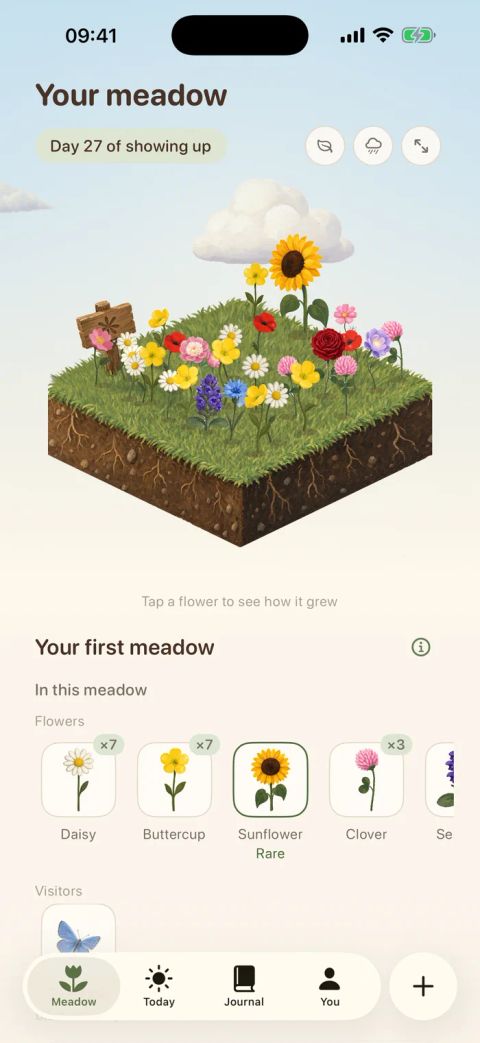
Goals hold up better when the small wins are in front of you, and that thinking sits behind Meadow, a gentle iPhone app from Wildcard Wellness. You log a short walk or a few minutes of movement, tick off a small daily habit, and every day you show up grows a wildflower in a meadow that's yours, with a quick note on your mood and energy if you fancy it. There are no streaks, so a missed day resets nothing and the flowers you've already grown stay put, which stops a slow week from reading as a failure. You can try it at Meadow.
For shrinking the daily action until it's almost too small to skip, our guide to tiny habits covers the how.
Common questions
Does setting a goal change anything, or is it wishful thinking? It changes what you pay attention to and how hard you work, which is where any result starts. The catch is that a goal only does this once it names a concrete action. "Be healthier" is still a wish. "Walk after lunch on weekdays" is a goal, and the difference is the whole point.
What's the point of a goal if I don't reach it? Even a missed goal will have steered your effort and taught you where your plan broke, which is more than no goal at all gives you. Aim for a version small enough that you clear it most weeks, so you bank the wins that carry you, and treat a miss as information about the size of the goal.
Are written goals better than ones in my head? The evidence points that way. In Matthews' study the people who wrote their goals down got further than those who only thought about them, and adding a weekly progress note to a friend helped more still. Writing pins the goal down and gives you something to check yourself against.
How many goals should I set at once? One or two. Locke and Latham found that piling on too many goals can drag performance down, and trying to overhaul your sleep, diet and exercise on the same Monday tends to end with none of them surviving. Get one action steady, then add the next.
Can setting goals ever make things worse? Yes. A goal set too high dents your confidence when you miss it, a rigid number can crowd out the enjoyment of something you're learning, and a goal aimed at the wrong thing sends your effort the wrong way. The fix is a reachable target you can adjust, not scrapping goals altogether.
Take the vaguest wish you're carrying and give it one specific action you could do tomorrow, at a time you can name. Write that single line down where you'll see it. It'll do more than the grand plan still drifting around in your head.
AUTHOR
Co-founder of Meadow.
Ash is co-founder of Meadow, a habit and movement tracking app that turns small acts of self-care into a growing wildflower meadow.
Little and often, with Meadow
Consistency, not intensity.
Meadow turns the movement you enjoy and the habits that help you feel good into a meadow of wildflowers. No streaks to break, and your flowers never wilt.
Download Meadow