Self-compassion means treating yourself with the same warmth you'd offer a good friend who was struggling. In practice, it's a handful of small habits you can start today: catching your harsh inner voice, softening it, and reminding yourself that a bad day is part of being a person.
Most of us are much kinder to other people than we are to ourselves. A friend forgets an appointment and we say, "It happens, don't worry." We forget one and we say, "What is wrong with me." Learning to close that gap is the whole practice, and it's one you can build slowly, on ordinary days.
This isn't therapy and it won't fix everything. It is a skill you can get better at with a little repetition, and there's decent evidence it helps you feel steadier and, on the days you'd expect it to backfire, keep going.
What self-compassion is
The psychologist Kristin Neff, who has spent much of her career researching this, describes self-compassion as three things working together.
- Self-kindness. You speak to yourself with care when things go wrong, instead of reaching for judgement. The tone is understanding, not critical.
- Common humanity. You remember that struggling, failing and feeling inadequate are part of the shared human experience. Everyone goes through it, even if it feels like only you.
- Mindfulness. You notice a painful feeling and let it be there, without either pushing it away or drowning in it. You can name it. "I'm angry, and that's okay." "This hurts."
The American Psychiatric Association sums it up as treating yourself "with kindness and gentleness" when you're going through something hard or you've fallen short. None of the three parts asks you to pretend the difficult thing didn't happen. They ask you to stay with it a bit more gently.
What it isn't
A lot of people hesitate here, so it's worth clearing up.
Self-compassion is not self-pity. Self-pity pulls you inward and tells you your problem is uniquely awful. Common humanity does the opposite, reminding you that other people know this feeling too, which tends to make it smaller and more bearable.
It isn't self-indulgence or letting yourself off the hook. And it doesn't mean dropping your standards. This is the worry that stops most people, the fear that being kind to yourself will make you lazy or complacent. The research points the other way. As the APA puts it, many people assume compassion will make them "lax towards their goals," but "the opposite is true," because you become more open to reflecting, learning from a mistake and changing. Cleveland Clinic makes a similar point: self-compassion isn't about wearing blinders or wallowing. It means accepting a hard moment while leaving room to grow from it.
Why it helps you keep going
Here's the part that surprises people. A harsh inner critic feels like it's driving you forward, but it often does the reverse.
In a set of four experiments, psychologists Juliana Breines and Serena Chen had people confront a failure or a personal weakness. Half were guided into a self-compassionate frame of mind, usually through a short writing exercise. Those people reported more motivation to improve and to make amends, and after failing a test they spent longer studying for the next one. Being kind to themselves didn't make them coast. It made them try again.
Michael Wohl and colleagues found something similar with procrastination. They followed first-year students across two rounds of exams. Among those who'd put off studying the first time, the ones who forgave themselves for it went on to procrastinate less before the next exams. Self-blame kept people stuck in the same pattern. Self-forgiveness let them move on and get to work.
There's a wellbeing side too. Higher self-compassion is associated with lower anxiety and depression, less rumination, and quicker recovery from setbacks. It's an association, not a cure, and everyone's different. But the direction is encouraging, and the practices below cost nothing to try.
Practical ways to practise
You don't need a cushion or half an hour. These are small, and they work best woven into a normal day.
- Talk to yourself like a friend. Next time you catch a harsh line running in your head, pause and ask what you'd say to someone you cared about in the same spot. Then say that to yourself, in those words. TherapistAid frames the shift well: "I made a mistake. I'm only human" instead of "I made a mistake. I always mess up." Same event, different voice.
- Take a self-compassion break. This is a short practice you can do standing in a kitchen or sitting at your desk, and it strings the three parts together in about a minute. There's a version below to keep.
- Notice common humanity. When you're low, add a quiet line: "Other people feel this too." Not to minimise what's happening, but to unhook the sense that you're the only one failing at it. You're joining the human race, not leaving it.
- Try a soothing hand. Put a hand on your chest or your stomach and take one slow breath. Physical warmth and a bit of steady pressure can settle the nervous system when your thoughts are racing, and it gives the kind words something to land on.
- Reframe a setback. After a miss, write two or three sentences about it as a friend would, kindly and without blame, then one line about the next small step. Harvard Health suggests exactly this, writing to yourself about a painful moment "without blaming anyone, including yourself."
A short practice to keep
When something's gone wrong and you feel the criticism starting, try this. It takes about a minute, and you can adapt the words until they sound like you.
Put a hand on your chest or wherever feels steadying, and take one slow breath in and out.
Say to yourself: this is a hard moment. Name what's going on, plainly.
Then: hard moments are part of being human, and other people feel this too.
Then: may I be kind to myself right now. Ask what you'd want a good friend to hear, and offer yourself that exact line.
Do it once and it might feel a little awkward. That's normal, and it fades. The words matter less than the turn you're practising, from attacking yourself to standing beside yourself.
Open our free Kinder thoughts worksheet (PDF). Write down a difficult moment, separate facts from a harsh judgement and choose a kinder response. Includes a small next-step prompt. Save or print it; no sign-up needed.
Somewhere to check in with yourself
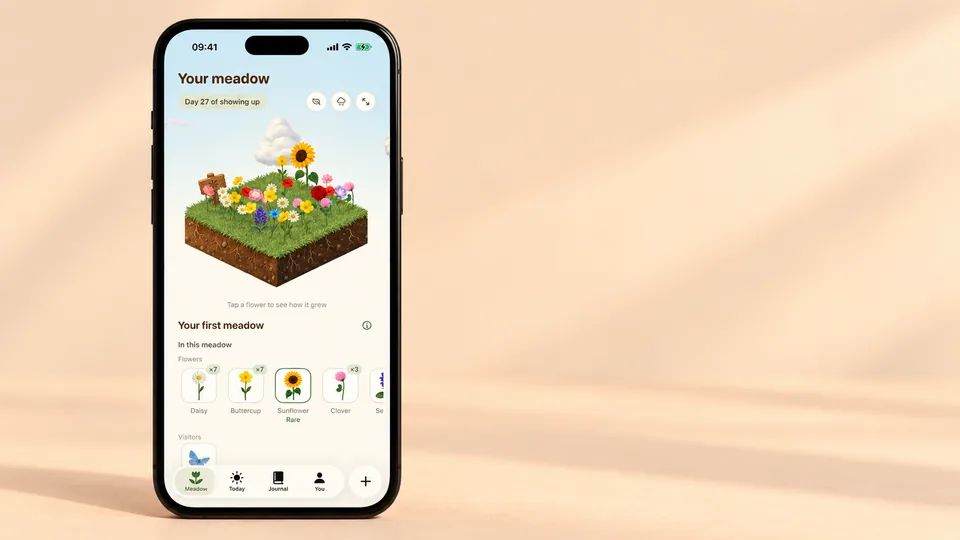
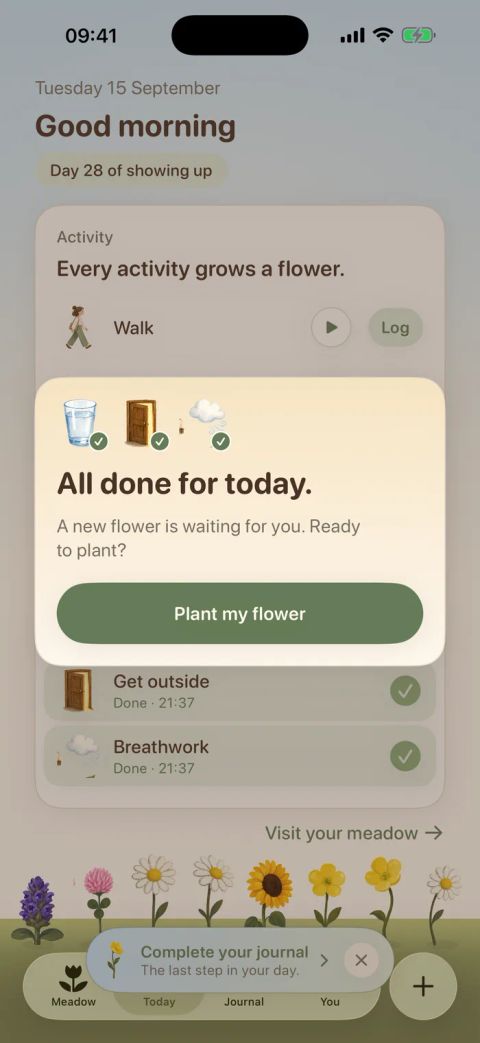
If a nudge on your phone helps the habit stick, Meadow is a movement and habit app built around checking in rather than keeping score. You note your mood and energy, write down one good thing from the day, and read a short encouraging line to start the morning. Each day you show up grows a wildflower in a meadow that's yours, and because there are no streaks, a day you skip wipes out nothing you've grown. You can take a look at Meadow here. For a slower, screen-free version of the same idea, our self-care ideas collection is a good place to browse.
It takes practice, and it's honest work
Self-kindness can feel false at first, especially if you've spent years being your own harshest critic. That's not a sign it isn't working. A new inner voice takes repetition, the way any habit does, and some days you'll forget entirely and only notice afterwards. Noticing afterwards still counts. Building it in small, regular doses is far kinder to yourself than trying to overhaul how you think in a weekend, and it's more likely to stick. If you want a hand with the mechanics of small, repeatable change, how to be consistent and our guide to mindfulness for beginners both sit alongside this one.
One honest caveat. Self-compassion is a practice, not a treatment. It sits well alongside other support, and it isn't a substitute for it. If low mood, anxiety or self-criticism feel heavy or won't lift, or they're getting in the way of daily life, please talk to your GP or a qualified therapist. In the UK you can also call Samaritans free on 116 123, any time, if things feel like too much.
Common questions
Is self-compassion the same as self-esteem?
No. Self-esteem tends to depend on feeling good about yourself, often by comparison with others, so it can wobble when you fail or fall behind. Self-compassion is there precisely when you've failed. It doesn't need you to be doing well first.
Won't being soft on myself make me lazy?
It's the common fear, and the evidence doesn't support it. In the studies above, people who treated themselves kindly after a setback were more motivated to improve, not less. Self-criticism is the thing more likely to leave you stuck.
How long until it works?
There's no fixed timeline, and anyone who gives you an exact number is guessing. Most people find the harsh voice softens gradually with regular, small practice. Treat it as something you get a little better at, not a box to tick.
What if the kind words feel fake?
Very common early on. Start smaller and more believable. "This is hard and I'm doing my best" is easier to accept than "I love myself," and you can grow the warmth from there.
Start here
Pick one moment today when you'd normally give yourself a hard time, running late, forgetting something, a task that didn't go to plan. Catch the critical line, put a hand on your chest, and say the one sentence you'd say to a friend. That's the whole practice. Do it once, and you've started.
AUTHOR
Co-founder of Meadow.
Ash is co-founder of Meadow, a habit and movement tracking app that turns small acts of self-care into a growing wildflower meadow.
Every little bit counts
Five minutes counts. So does a dance in the kitchen.
Log the movement you enjoy and the small habits that help you feel good, and watch them bloom into something you can see.
Download Meadow