Motivation isn't a mood that turns up if you wait long enough. It comes from a few specific places, and once you know where to look, you can go and get some instead of hoping it finds you.
That's the shift worth making. Most of us treat motivation like weather, something that happens to us, so we sit tight on a flat day and wait for the drive to come back. It rarely does on its own. The people who seem endlessly motivated aren't luckier with the weather. They know where the feeling comes from and they set things up to draw it out.
This is the broad map: where motivation comes from, why waiting for it backfires, and the handful of reliable ways to find some when the tank reads empty. If you want the quick in-the-moment lift, that's how to boost motivation. If you want to keep it going once you've got it, that's how to not lose motivation. This piece is the ground underneath both.
Where motivation comes from
Motivation has sources, and they're worth naming, because most of the time a flat day is one of them running dry.
The clearest account comes from self-determination theory, the decades-long research of psychologists Edward Deci and Richard Ryan. They separate two kinds of drive. One is intrinsic, doing a thing for its own interest or satisfaction. The other is extrinsic, doing it for a reward or to dodge disapproval. Their work argues that autonomy, competence and relatedness are the conditions that support the most self-driven, high-quality forms of motivation. Autonomy is the sense that it's your own choice. Competence is the sense that you're getting better at it. Relatedness is the sense that it ties you to people you care about.
Read that as a checklist for where your drive has gone. A goal that feels imposed has lost autonomy. One where you never see yourself improving has lost competence. One you do entirely alone can lose relatedness. Put meaning on top, a reason the thing counts to you, and a bit of momentum from having started, and you've got the full set of taps motivation flows from.
The practical upshot is that you don't find motivation by squeezing harder. You find it by turning one of these taps back on.
Why waiting to feel motivated fails
The common plan is to wait until you feel like it, then act. On a good day that works fine, because the feeling's already there. On a flat day it strands you, because the feeling is the thing that's missing, so you wait, and nothing comes.
James Clear puts the order the other way round. As he writes, "motivation often comes after starting, not before", and "it's hard to think yourself into getting motivated." The drive tends to follow the action by a few minutes.
There's a clinical version of the same idea. Behavioural activation, an approach used for low mood, asks people to increase their level of activity even if they don't feel like it to begin with, on the basis that doing valued things tends to lift mood back up, while waiting to feel better first keeps you stuck. Action first, feeling second.
So the rest of this is less about summoning a feeling and more about the moves that produce one.
Reconnect to a why that's yours
Motivation borrowed from someone else burns out fast. If you're walking because a headline nagged you, or cutting sugar because a comment stung, the reason was never yours, and there's little in the tank to draw on once the guilt fades.
Finding your own reason is often the quickest refill. Not the reason you think you should have, the one you feel. "I want to keep up with my kids on a bike ride" pulls harder than "I should exercise." Make it concrete and a bit selfish and it'll carry more weight.
Here's a short check you can copy onto paper when a goal has gone flat. Fill it in one line at a time:
Where's my motivation coming from?
The task: ________
Whose idea it is: ________
What I'd get that I want: ________
The smallest bit I could enjoy: ________
Filled in on a stalled week, it might read:
Where's my motivation coming from?
The task: go to the gym three times
Whose idea it is: a New Year post I half-remember
What I'd get that I want: sleep better, less back ache
The smallest bit I could enjoy: the sauna after
That second version has a reason worth keeping and a bit you'd look forward to. That's a goal you can find motivation for, where the first was borrowed and joyless.
Get one small win
Nothing refills the tank faster than finishing something. A completed thing, however small, hands you a hit of progress you can spend on the next thing.
This is one of the better-evidenced points in the whole area. Teresa Amabile and Steven Kramer analysed thousands of workday diaries and found that making progress in meaningful work was the strongest day-to-day boost to people's mood and motivation, while a setback drained it. They called it the progress principle.
The trap is that a big goal offers no early win. It sits there whole and daunting, giving you nothing until it's done. So shrink the first step until it's almost too small to refuse. "Get fit" becomes "shoes on, walk to the end of the road." "Sort my finances" becomes "open the banking app and look." Do that, and you've swapped a stuck feeling for a moving one, and moving is where motivation lives.
Make it something you'd enjoy
Enjoyment is a source of motivation people skip, as though the worthy version of a goal has to be the joyless one. The opposite holds. The bit you look forward to is the bit that brings you back tomorrow.
So choose the version you like. A walk with a podcast. A tidy with loud music on. The run route past the good view, or the class where your friend will be. In self-determination terms you're feeding the intrinsic kind, the drive that lasts, by making the activity satisfying in itself. If it's movement you're trying to find the drive for, there's more in exercise motivation.
Act first, then make starting easy
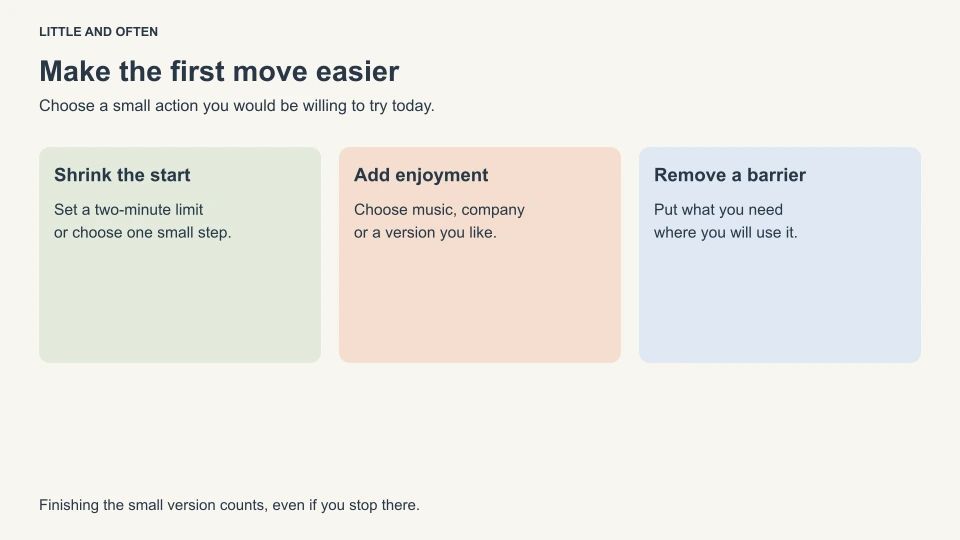
Since the doing tends to produce the wanting, the whole game is getting yourself to start. Two things help. Shrink the gap between deciding and starting, and stack the room in your favour so starting takes almost no effort.
Set a two-minute timer and agree you only have to last the two minutes. Most of the time you'll carry on, because starting was the hard part and you're now past it. If you stop at two minutes, you've still done more than an afternoon of waiting.
Then clear the friction before you need it. James Clear calls the space around you "the invisible hand that shapes human behavior" and suggests making the action you want the obvious option in the room. Lay the kit out the night before. Fill the water bottle and leave it on the desk. Put the book on the pillow. Each cleared step is one fewer excuse waiting for the tired version of you who shows up later. There's more on wiring small actions into your day in tiny habits.
Borrow the pull of a fresh start
Some moments hand you motivation for free. The start of a week, the first of the month, a birthday, the Monday after a washout. Beginning on one of those gives you a real nudge.
Researchers Hengchen Dai, Katherine Milkman and Jason Riis called this the fresh start effect. Across three studies they found gym visits, searches for "diet" and commitments to goals all rose after temporal landmarks like a new week, month or year. These moments tuck your recent stumbles into the past and let you open a clean page.
Use one when it's there. And when it isn't, declare one. The next fresh start is always closer than the calendar suggests. Tomorrow morning. The next hour. The next meal. You can start from any of them.
Somewhere to watch it build
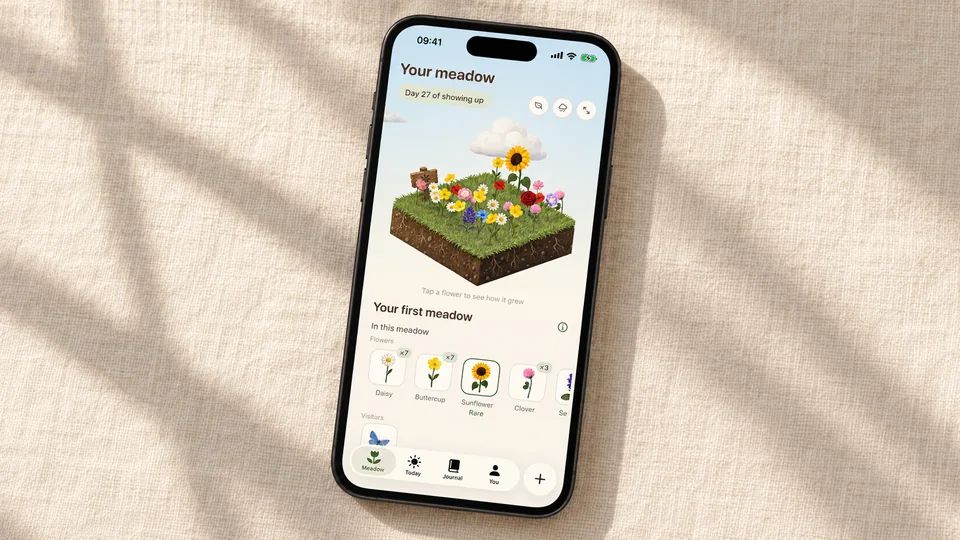
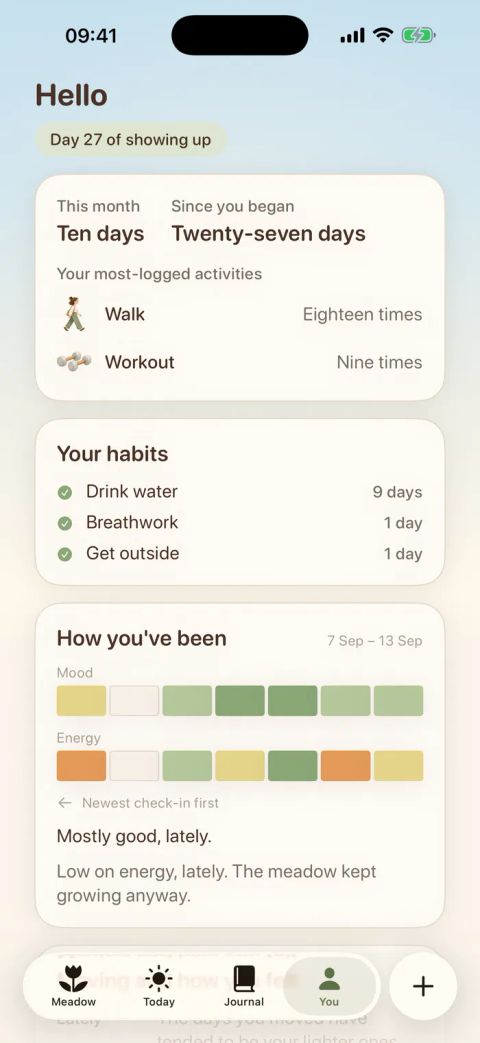
When the drive is hard to find, seeing proof you've already shown up can supply a little. Meadow is built around that. It's a gentle iPhone app from Wildcard Wellness where every day you turn up, by logging a bit of movement or ticking off a small habit, grows a new wildflower in a meadow that's yours. The small wins this article is about stop being invisible and become something you can look at.
The part that fits a low-motivation stretch is how it treats a gap. There are no streaks, so a missed day or a quiet fortnight resets nothing and your flowers never wilt. You can note your mood and energy while you're there and write down one good thing from the day, then pick the habit back up whenever you're ready.
A few common questions
Where does motivation come from? From a handful of sources: a reason that's your own, a sense you're getting better, a connection to other people, the enjoyment of the thing itself, and the momentum of having started. A flat day is usually one of those having run low, and finding motivation means turning one back on.
How do I find motivation when I have none? Don't wait to feel it. Do the smallest version of the task, the two-minute, shoes-on version, and let the action bring the feeling along behind it. Then reconnect the task to a reason you care about.
Why can't I find any motivation lately? Low drive usually tracks something underneath, often tiredness, stress, a run of dull days, or a goal that was never yours. Check the obvious causes first, sleep especially, and make sure the reason behind the goal is one you'd choose. If the flatness has lasted weeks alongside low mood or poor sleep, it's worth a word with your GP, since persistent low motivation can have a cause worth looking at.
Is motivation something you have or something you find? A bit of both. It rises and falls on its own, so you won't always have it to hand. But you can reliably find some by pulling one of the levers here, which is why the knack is knowing where it comes from, not waiting to be handed it.
Pick the one goal that's gone flat and fill in the four lines above: the task, whose idea it is, what you'd get that you want, and the smallest bit you could enjoy. Then do that smallest bit today, before you feel ready. The motivation will meet you on the way.
AUTHOR
Co-founder of Meadow.
Ash is co-founder of Meadow, a habit and movement tracking app that turns small acts of self-care into a growing wildflower meadow.
See how far you've come
Your habits, moods and little wins, all in one place
Meadow keeps track of the walks, the water and the good days, so you can look back and watch your effort add up.
Download Meadow