When your motivation is on the floor, the fastest way to raise it is to stop waiting for the feeling and do one small thing that gives you a win. Action tends to come first, and the drive shows up a few minutes behind it.
That runs against the usual advice, which tells you to psych yourself up until you feel ready. Waiting to feel ready is the trap. On a low day the feeling doesn't arrive on cue, so the trick is to do something small enough that it doesn't need the feeling, then let the small thing pull your mood up after it.
Here's how to lift your motivation now, when it's low, using a handful of levers you can pull today. This is about the boost in the moment. If you want the longer game of keeping it once you've got it, we cover that in how to not lose motivation.
Start with a win small enough to get
The quickest lever is a single completed thing. Pick the smallest honest version of whatever you're avoiding, do it, and let the sense of done do the rest.
There's good research behind this. Teresa Amabile and Steven Kramer analysed thousands of workday diaries and found that the strongest day-to-day lift to people's mood and motivation was making progress on meaningful work, even a small step forward. They called it the progress principle. A win, however tiny, feeds the drive to keep going, and a setback drains it.
The catch is that a big task offers no early win. It sits there, whole and daunting, giving you nothing until it's finished. So cut it down until the first step is almost laughably small. "Clean the house" becomes "clear one surface." "Go for a run" becomes "put your shoes on and step outside." If it's the report you're dreading, the first move is opening the file and typing the heading.
Do that one small thing and you've changed your state. You've gone from stuck to moving, and moving is a much easier place to add the next step from.
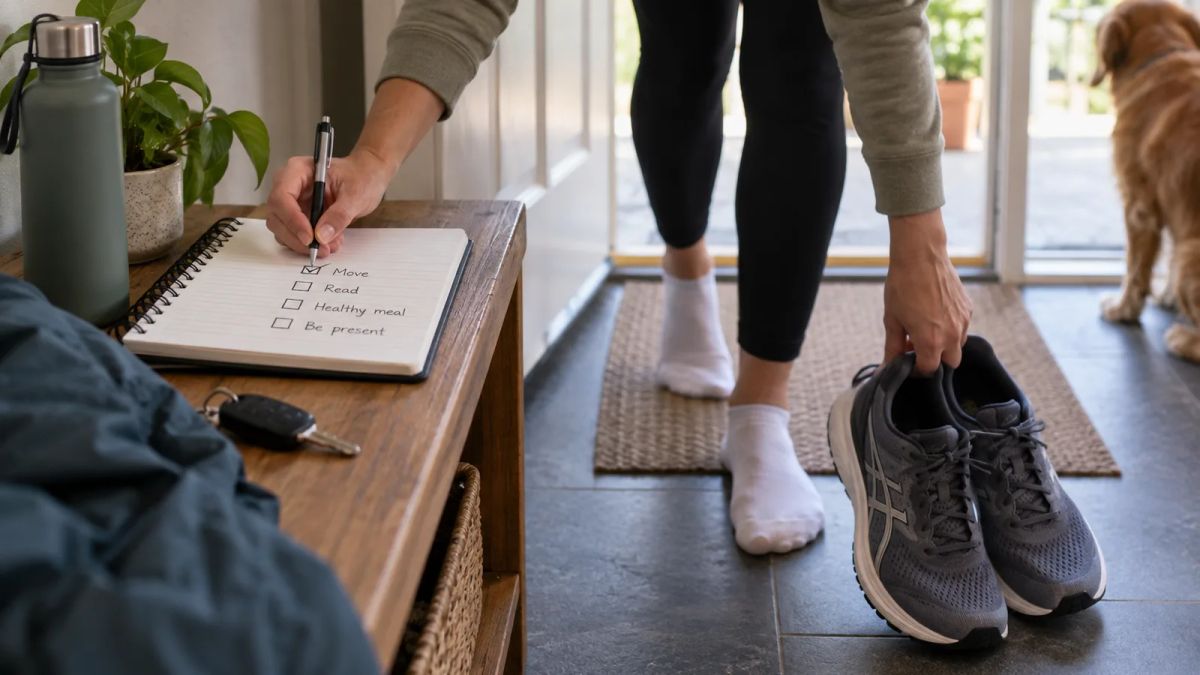
Make the win visible too, because a win you can see keeps pulling. Jot the day's small thing on a sheet by the kettle. Here's a blank you can copy for the week:
This week's first moves
Goal: ________ Smallest version: ________
Mon: ________ Tue: ________ Wed: ________ Thu: ________
Fri: ________ Sat: ________ Sun: ________
Filled in on a slow week, it might look like this:
This week's first moves
Goal: tidy the flat Smallest version: clear one surface
Mon: cleared the desk Tue: one shelf Wed: skipped
Thu: kitchen counter Fri: skipped Sat: whole kitchen Sun: hoovered
Two blank days and the run's still going. Seeing the ticks add up is a small hit of motivation on tap, which is the whole point of a record you glance at.
Do it first, feel like it after
The stubborn belief is that motivation has to come before action. Flip the order. On a flat day, the doing produces the wanting, not the other way round.
This is the idea behind behavioural activation, an approach used for low mood. Its core move is to increase your activity even if you don't feel like it to begin with, because getting active tends to lift mood and interest back up, while waiting to feel better first keeps you stuck in the flat spot. You schedule a small, valued thing and you do it before the mood turns, and often the mood turns because you did.
In practice that means shrinking the gap between deciding and starting. Set a two-minute timer and tell yourself you only have to last the two minutes. Nine times out of ten you'll carry on once you're in, because starting was the hard part and you're now past it. If you stop at two minutes, you've still done more than a whole day of waiting produced.
One honest caveat. If your motivation has been on the floor for weeks, alongside low mood, poor sleep or no interest in things you used to enjoy, that's worth a word with your GP. Persistent low drive can have a cause worth looking at, and behavioural activation is a treatment approach best used with support in that case.
Make the reason yours
Motivation borrowed from someone else runs thin fast. If you're pushing through because a headline told you to, or because you feel you ought to, there's not much fuel in the tank to draw on. Reconnecting to a reason that's yours can top it back up in a minute.
Self-determination theory, the long-running research from psychologists Edward Deci and Richard Ryan, sorts the fuel into two kinds. Doing something for its own interest or satisfaction lasts better than doing it for an outside reward or to avoid a telling-off, and three things feed the durable kind. Autonomy is the sense that it's your own choice. Competence is the sense that you're getting better at it. Relatedness is the sense that it connects you to people you care about.
You can lean on all three to get a lift right now:
- Reword the task so it's a choice, not an order. "I want to walk because my head clears afterwards" pulls harder than "I have to exercise."
- Pick a version you can already do well, so you get a taste of competence in the next ten minutes instead of some far-off week.
- Rope in a person. Message a friend you'll go together, or do the thing near someone, and the relatedness carries you when the discipline won't.
While you're choosing, choose the version you enjoy. A walk with a podcast, a tidy with music on, the run route past the good view. Enjoyment does real work here. It's the part that makes you want to come back tomorrow. There's more on this for movement specifically in exercise motivation.
Borrow the pull of a fresh start
Some moments carry their own charge. The start of a week, the first of the month, a birthday, the morning after a break. Use one and you'll feel a genuine nudge to begin.
Researchers Hengchen Dai, Katherine Milkman and Jason Riis called this the fresh start effect. Across three studies they found that gym visits, searches for "diet" and commitments to goals all rose after temporal landmarks like a new week, month or year. These moments file your recent stumbles under "before" and let you open a clean page.
The lever is real, so pull it when it's there. Let a Monday morning or the first of the month be the day you begin again, and ride the lift it gives you.
Don't sit around waiting for one, though. The next fresh start is always closer than the calendar suggests. Tomorrow morning is a fresh start. The next hour is a fresh start. You can declare one whenever you need it and start from there.
Clear one obstacle out of the way
Sometimes the drive is fine and the friction is the problem. Every extra step between you and the task is a small excuse to skip it, and on a low day those small excuses win.
James Clear, who wrote Atomic Habits, puts a lot of weight on your surroundings. "Environment is the invisible hand that shapes human behavior," he writes, and the fix is to make the thing you want to do the easy, obvious option in the room. Put the guitar on a stand in the middle of the living room and you'll play it. Bury it in a cupboard and you won't.
So spend two minutes making the next action easier before you need it. Lay your gym kit out the night before. Fill the water bottle and leave it on the desk. Put the book on your pillow. Close the tabs that pull you off course. You're spending a tiny bit of effort now, while you have it, to remove the friction that would beat you later, when you don't.
The flip side works for the habits you're trying to drop. Add steps and hide cues, so the biscuit tin lives on a high shelf and the phone charges in another room. We go into building the routine around all this in how to be consistent.
See the small wins add up
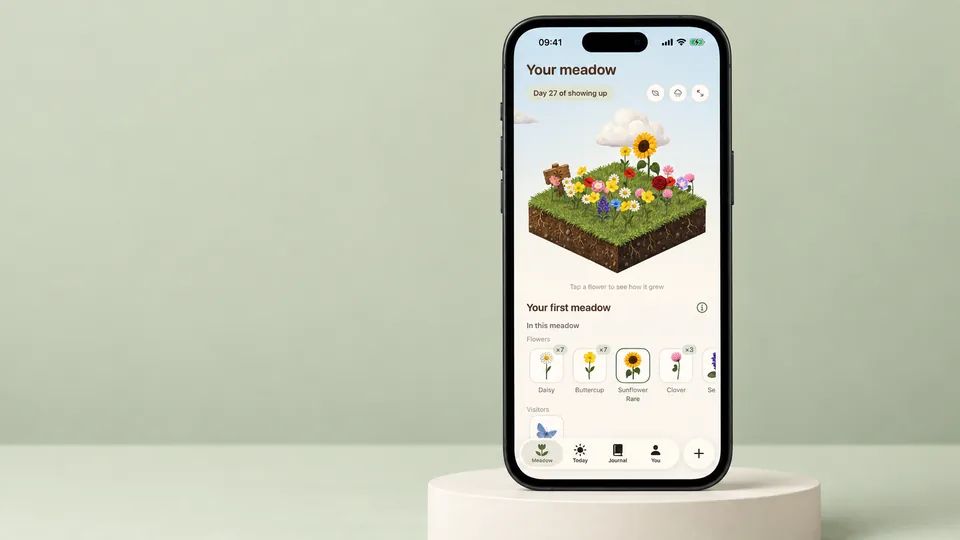
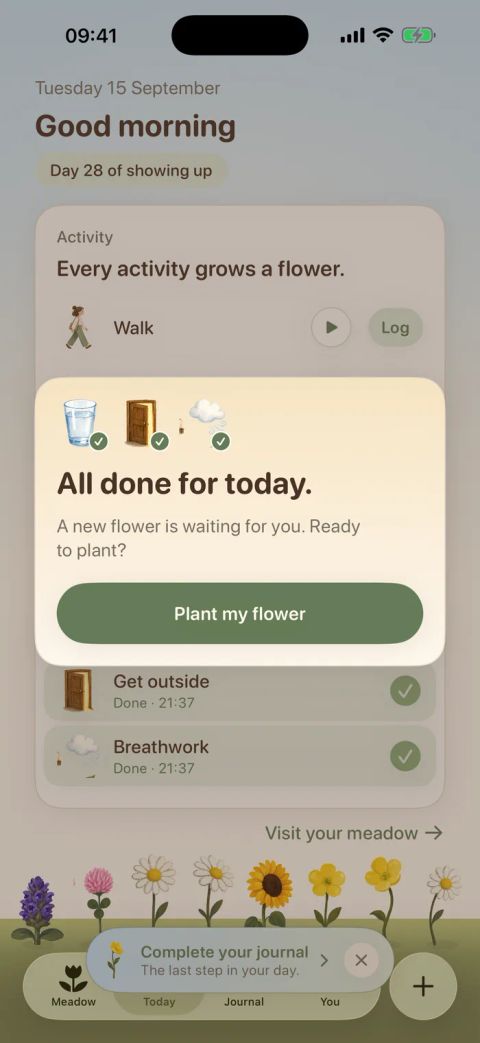
A phone can help here, as long as it cheers you on instead of nagging you. Meadow is built to do the cheering. It's a gentle iPhone app from Wildcard Wellness where every day you show up, by logging a little movement or ticking off a small habit, grows a new wildflower in a meadow that's yours. The small wins you're chasing turn into something you can watch fill in.
What suits a low-motivation day is how it treats a gap. There are no streaks, so a skipped day or a flat week resets nothing and your flowers never wilt. You can note your mood and energy while you're there and jot down one good thing from the day, then pick the habit back up the moment you're ready. No clean slate required, and no scolding for the days you missed.
A few common questions
How do I motivate myself when I have zero motivation? Don't try to feel motivated first. Do the smallest possible version of the task, the two-minute, one-surface, shoes-on version, and let the action bring the mood along behind it. Starting is the hard bit, and starting tiny gets you past it.
Why do I have no motivation to do anything? Low drive usually tracks something underneath it, often tiredness, stress, a run of dull days, or a goal that was never yours to begin with. Check the obvious causes first, sleep and rest especially, and reconnect the task to a reason you care about. If the flatness has lasted weeks and nothing lifts it, mention it to your GP.
What's the fastest way to feel motivated? Get one quick win. Finish a single small thing you've been putting off and the sense of progress gives you an immediate lift, which you can spend on the next small thing.
Is low motivation a sign of laziness? No. Motivation naturally rises and falls with mood, energy and novelty, and a flat spell is a normal part of the pattern, not a character flaw. The people who keep going aren't more motivated, they've set things up so a low day still ends with something done.
Pick the one task weighing on you most today and cut it down to a version so small it would be strange not to do it. Then do that version now, before you feel ready. The motivation can catch up once you're moving.
AUTHOR
Co-founder of Meadow.
Ash is co-founder of Meadow, a habit and movement tracking app that turns small acts of self-care into a growing wildflower meadow.
Every little bit counts
Five minutes counts. So does a dance in the kitchen.
Log the movement you enjoy and the small habits that help you feel good, and watch them bloom into something you can see.
Download Meadow