Willpower is the effort it takes to resist a short-term temptation so you can stick with a longer-term goal. It's the in-the-moment push to do the hard thing when something easier is tugging at your sleeve, and while it's real, it turns out to be a weak and unreliable engine to run a life on.
The odd part, once you read the research, is that the people who look most disciplined lean on it least. They don't win by out-muscling the biscuit tin. They set things up so the biscuit tin comes up less often.
This guide covers what willpower is once you strip away the myths, why the popular "willpower as a fuel tank" idea is on shaky scientific ground, why willpower is such an unreliable thing to depend on, and how it differs from self-discipline and habits. If you want the practical how-to for building the good stuff, our guide to self-discipline is the place for that. This one is about understanding the thing itself.
What willpower is
Psychologists tend to describe willpower as a few related abilities working together. You delay a reward now to get a bigger one later. You resist a short-term temptation to meet a long-term goal. You override an impulse, a craving or an unwanted thought. You keep a cool, thinking part of your mind in charge when a hot, emotional part wants to take the wheel.
In plain terms, willpower is you regulating you, in the moment, by force of effort.
That's the narrow version. It's the feeling of gritting your teeth past the second glass of wine, or staying in the chair when the sofa is calling. It's conscious, it's effortful, and you can feel it working.
The American Psychological Association's review of the science reports that willpower is linked to a range of good life outcomes, from better grades to steadier finances and better physical and mental health, and that most people believe it can be learned. That much holds up. Where things get messy is the story about how it works.
Is willpower the same as self-discipline?
In everyday speech, people use willpower, self-control and self-discipline as if they mean one thing. Researchers pull them apart, and the difference is the useful bit.
Self-discipline, or self-control, is the broad ability to steer yourself towards what you care about. Willpower is one narrow tool inside that, the moment-to-moment resistance. The gap shows up most clearly in how disciplined people behave. As Science News reports, the field went through what one researcher called a seismic shift when studies found that people high in self-control "don't inhibit all day long." They do something different. They plan ahead so the temptation is weaker before it arrives, an approach sometimes called strategic self-control.
Think of Odysseus tying himself to the mast before the Sirens sang. Muscling through the song while untied would be willpower. Tying yourself up first, so there's less to resist, is self-discipline doing its job. One is a fight. The other is a setup that means the fight barely happens.
Willpower sits inside self-discipline, and it's the part disciplined people use sparingly. That's the first clue that leaning on it heavily is the wrong plan.
The muscle idea, and why it's on shaky ground
You've probably heard that willpower works like a muscle. Use it in the morning and it's tired by the afternoon, so a hard day leaves you weaker and more likely to cave by evening.
That idea has a name, ego depletion, and a famous origin. In 1998, the psychologist Roy Baumeister ran an experiment where people who resisted a plate of fresh cookies later gave up sooner on a difficult puzzle, as though restraint had drained a shared tank. The paper describing it has been cited more than 4,800 times and became one of the best-known ideas in psychology. It's the reason so much self-help talks about a daily willpower budget.
Then it met the replication crisis. In 2016, 23 labs re-ran the effect with around 2,000 people under agreed rules, and the pooled result was trivial in size and not significantly different from zero. Later attempts landed in much the same place.
The debate hasn't fully closed. Baumeister still argues the effect is real, and some evidence points to belief doing a lot of the work. In one study, people primed to think willpower is limited showed the depletion effect, while those primed to think it isn't showed the opposite, which hints the tank might be partly in your head. What the honest reading rules out is the strong version, where every act of restraint spends a fixed pot of fuel. Don't plan your day around a willpower meter, and don't treat a tired Tuesday evening as proof you've run out.
Why willpower is such an unreliable engine
Set the tank debate aside, and willpower is still a shaky thing to build on. It works, but it works least when you need it most.
It's strongest when you're fresh and calm. It thins out when you're tired, hungry, stressed or a bit fed up, which describes most people by 9pm. It rides your mood. And every time you leave a choice up to willpower, you open a negotiation with yourself, and negotiations can be lost. "Should I go for a walk today?" is a question you might answer no. A person who decided the night before, laid their trainers by the door and settled it in advance has no argument to have.
Here's the practical read. A plan that needs willpower every single day is a plan built for your best days, and your best days aren't most days. Anything you want to keep doing for months has to survive the flat, rushed, unmotivated version of you, and that version has almost no willpower to spare.
How habits are different
A habit is a behaviour that's become automatic, so it needs little or no willpower to run. You don't summon resolve to brush your teeth. You do it because a cue turns up, in the same spot every day, and the action follows on its own.
This is the mechanism disciplined people quietly rely on. Brian Galla and Angela Duckworth found across six studies of 2,274 people that those with better self-control reported stronger beneficial habits and less effortful inhibition, and that those habits, more than white-knuckle resistance, explained their good outcomes. Their exercise, study and sleep routines ran automatically, so there was less to resist in the first place.
The psychologist Denise de Ridder describes the same pattern from another angle. As Scientific American reports, naturally self-controlled people build routines that rarely expose them to temptation, so the choice they wanted is already the automatic one.
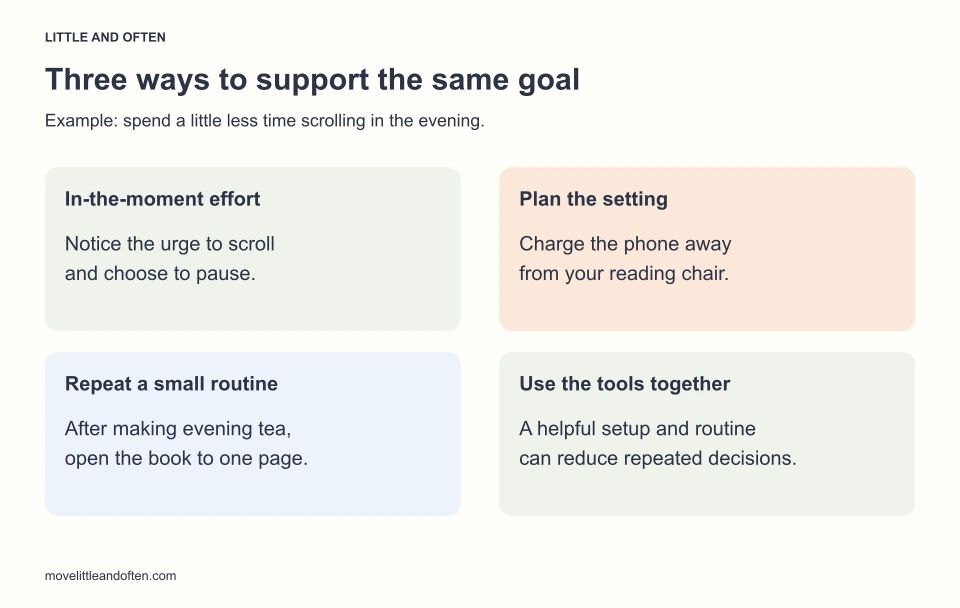
The trade you're after is clear. Willpower is expensive and runs low. Habits are cheap and run on their own. Every action you turn into a habit is one you no longer have to spend willpower on, which frees the small amount you have for the hardest, one-off moments. If you want to understand how habits form and hold, our guides to the four laws of behaviour change and how to be consistent go into the mechanics.
Can you build more willpower?
A bit, probably. The APA's review notes that regularly exerting self-control may strengthen it over time, the way a muscle gets stronger with use, even though it tires in the short term. Small acts of restraint, practised often, seem to help.
The better bet, though, is to need less of it. Every hour you spend trying to grow a bigger willpower tank is an hour you could spend building a habit or changing your surroundings so the tank barely gets touched. Aim to become a person who needs willpower less often, not one who can grind harder.
Make the good choice the easy one
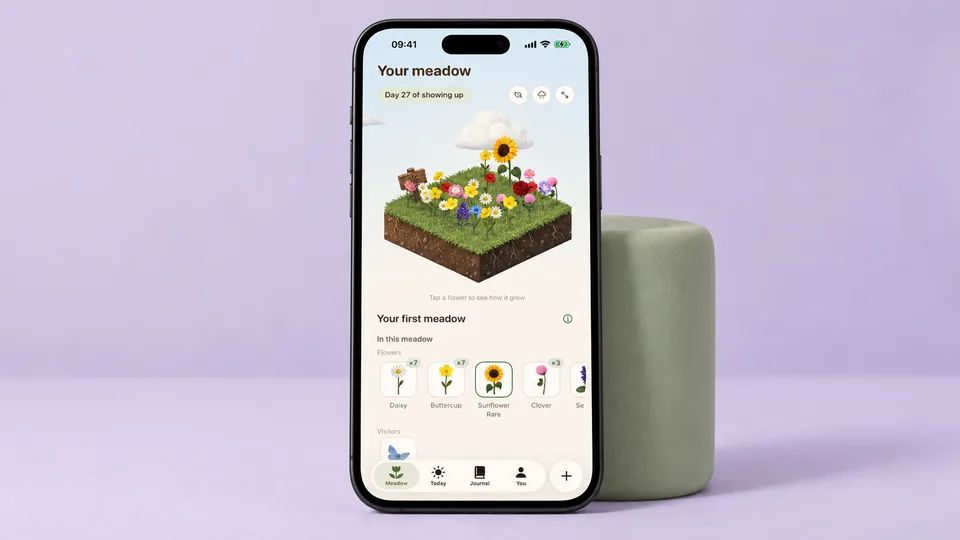
When the thing you want to do is already set up and waiting, willpower has almost nothing to resist, and that's the thinking behind Meadow, a gentle iPhone app from Wildcard Wellness. You log a little movement or tick off a small habit, and each day you show up grows a new wildflower in a meadow that's yours, with a quick note on your mood and energy if you fancy one. There are no streaks, so a missed day resets nothing and the flowers you've already grown stay put, which keeps a slip from turning into a reason to quit. You can try it at Meadow.
Common questions
Is willpower a limited resource that runs out? The popular version of that idea, ego depletion, is contested. A large 2016 replication across 23 labs found the effect close to zero, and the strong "fixed fuel tank" model doesn't hold up well. Some researchers think belief and context matter more than any resource draining away. So treat the daily willpower budget as a story, not a law.
What's the difference between willpower and self-discipline? Willpower is the narrow, in-the-moment effort of resisting a temptation. Self-discipline is the broader ability to keep steering towards your goals, and it includes strategic moves made in advance, plus the habits and surroundings that mean you don't have to fight in the first place. Disciplined people use willpower sparingly.
Why do I always lose it in the evening? Because by then you're usually more tired, hungrier and more worn down by the day's decisions, so the effort feels harder to summon. The fix is less about trying harder at 9pm and more about moving the hard choices earlier, or removing them, so evening-you has less to decide.
Is willpower the same as motivation? No. Motivation is the feeling that makes you want to act, and it comes and goes with your mood. Willpower is the effort you spend when the feeling isn't there. Both are unreliable, which is why habits and setups, the things that don't depend on how you feel, do the steadier work.
Pick one thing you keep relying on willpower for, and change something so you need less of it. Lay tomorrow's kit out tonight, move the biscuits to a cupboard you have to stand up to reach, or set the walk to follow lunch every day. That one change does more for you than any amount of trying to want it harder.
AUTHOR
Co-founder of Meadow.
Ash is co-founder of Meadow, a habit and movement tracking app that turns small acts of self-care into a growing wildflower meadow.
See how far you've come
Your habits, moods and little wins, all in one place
Meadow keeps track of the walks, the water and the good days, so you can look back and watch your effort add up.
Download Meadow