A goal-setting worksheet is a single page that turns a vague ambition into decisions you've already made. You write down the exact action, the reason you want it, the moment it happens, the thing likely to stop you and the date you'll check in, and the goal stops living in your head, where it can quietly rewrite itself into something easier.
The blanks do the work. Each one drags out a choice you'd otherwise dodge, and once the choices are made on paper you don't have to make them again at seven on a wet Tuesday when you'd rather not.
This guide walks through the worksheet one box at a time, explaining what goes in each and why, then hands you the sheet itself, blank and filled in, to copy before you close the page. For the wider theory of what makes a goal hold, how to set goals covers the full toolkit. Here the job is the page in front of you.
Start with the action, not the ambition
The first box is the one people rush. They write "get fit" or "eat better" and feel a little glow of intent, and then they're stuck, because there's nothing in that sentence to do this afternoon.
Edwin Locke and Gary Latham spent decades testing what a workable goal looks like. Across hundreds of studies they found that specific and difficult goals produce higher performance than vague or easy ones, because a clear target tells you where to put your effort while "do your best" gives you nowhere to aim. A goal has to be clear, it has to stretch you a bit, and it can't be so tangled you drown before you begin.
In the first box, write the action. Not "get fit" but "walk for twenty minutes after lunch on weekdays". Not "eat better" but "one piece of fruit with breakfast". You're looking for a line specific enough that a stranger reading it would know exactly what to do and when.
Keep the size honest. If the action only fits on a calm day, it belongs to the calm days alone, and most of yours won't be calm.
Name why you want it
The second box asks what the action is for. Not the tidy answer you'd give out loud, the real one underneath.
More energy by the evening. Being able to keep up with the kids on the stairs. A body that doesn't ache when you get out of the car. This box doesn't set the plan, but it's the line you'll come back to on the days the action feels pointless, so make it something true rather than something that sounds good.
Write it in your own words, plainly. "I want to stop feeling knackered by four o'clock" does more for you than "improve my wellbeing", because you can feel the first one and the second is a phrase off a poster.
Break it into process milestones
The third box is where most worksheets go wrong. They ask for milestones and you write outcome numbers: lose half a stone by March, run 10k by summer. The trouble is you don't fully control those. Your weight answers to sleep, stress and a dozen things today can't touch.
James Clear puts the split cleanly. Goals set your direction and your daily system delivers the progress, and holding the rudder gets you nowhere on its own, you have to row. Two people can hold the same goal and get different results, and the gap between them is the process each one runs.
Fill this box with process markers, the things you can guarantee by turning up. Walked three times this week. Stretched every morning for a fortnight. Ten sessions logged by the end of the month. These are milestones you reach by doing the action, not by hoping the scales cooperate, and hitting them keeps you in the game long enough for the slower results to show.
Decide the exact moment with an if-then plan
Wanting to do the action and doing it are two different problems, and the gap between them is usually a missing decision about when and where.
The psychologist Peter Gollwitzer studied a fix he called the implementation intention, an if-then plan that spells out the situation and the response: if situation Y happens, then I'll do behaviour Z. You pre-decide the moment, so when it arrives you're not negotiating with yourself, the cue does the reminding and the plan does the deciding. A pooled analysis put the effect of this kind of planning in the medium-to-large range.
Anchor the "if" to something that already happens every day. The American Heart Association's advice for making habits stick is to attach the new action to an established routine, so a cue you can't miss sets it off. If I've poured my morning coffee, then I take my vitamins. If it's Monday, Wednesday or Friday lunchtime, then I change my shoes and walk the block. The old routine becomes the alarm clock for the new one.
Face the obstacle before it turns up
The fifth box is the one that feels gloomy and does the most good. It asks what's most likely to stop you, and then what you'll do about it.
Picturing the happy ending, oddly, tends to sap the drive to chase it. Gabriele Oettingen found that part of the mind treats the daydream as the reward and slackens off. Her method, boiled down to four steps called WOOP, for wish, outcome, obstacle and plan, turns you towards the barrier instead. You hold the outcome you want next to the real thing in the way, which she calls mental contrasting, then write an if-then plan for the obstacle. A review of 24 studies covering nearly 16,000 people found WOOP produced a small-to-moderate improvement in whether people reached their goals, and it works best written down.
Name your obstacle in one line and answer it in the next. If I get home and want to flop on the sofa, then I keep my coat on and walk to the postbox first. If it's raining at eight, then I do the stretch indoors. You've cast your vote in advance, so the bad moment doesn't get one.
Set the review date now
The last box is a date. A goal set in January and never looked at again is a goal you'll have forgotten by February, and the review is what keeps it from drifting off without you noticing.
Watching your own progress does real work. A meta-analysis of 138 studies found that prompting people to monitor their progress towards a goal improved how often they reached it. Pick a day, once a week, and pick where the marks go: a tick on the wall calendar, a note on your phone, a line in a notebook. Whatever you'll see and not ignore.
At the review, ask three plain questions. Did I do the action most days? If not, was the action too big or was the obstacle plan wrong? What one thing would make next week easier? Then change the sheet. If the action feels trivial, nudge it up. If you keep missing, shrink it or rewrite the if-then plan for the obstacle that keeps winning. The worksheet is meant to be edited, not obeyed.
The worksheet
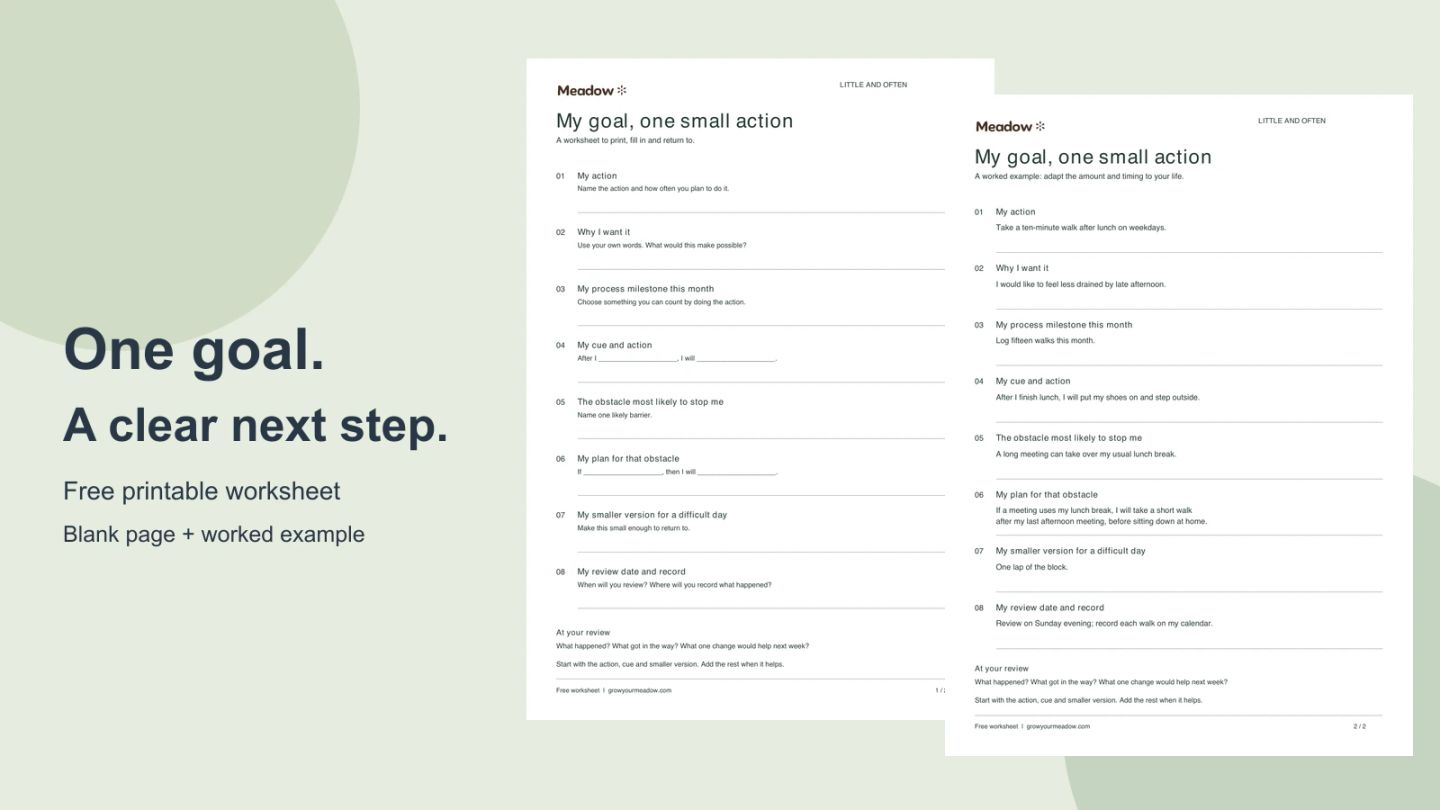
Here's the whole thing on one page. Copy it out, fill in the blanks, and stick it where the action happens, on the fridge, by the kettle, inside the front door:
Open our free Goal-Setting Worksheet (PDF). Includes a blank worksheet and a worked example. Save or print it; no sign-up needed.
My action (specific, most days): ________
Why I want it: ________
My process milestone this month: ________
After I ________ , I will ________
The obstacle most likely to stop me: ________
If (obstacle) ________ , then I will ________
My smaller version for a bad day: ________
I'll review this on: ________
Filled in, it might read like this:
My action (specific, most days): A ten-minute walk after lunch
Why I want it: I want to stop feeling wiped out by four o'clock
My process milestone this month: Fifteen walks logged by the 30th
After I finish lunch , I will put my shoes on and step outside
The obstacle most likely to stop me: I get stuck at my desk and the afternoon disappears
If it's 1pm and I'm still at my desk , then I will shut the laptop and walk before I eat
My smaller version for a bad day: One lap of the block
I'll review this on: Sunday evening, with a cup of tea
Keep a smaller version for the hard days
That bad-day line on the sheet earns its place. Decide now, while you're thinking clearly, what the action shrinks to on a day when even the small version feels like too much. One lap instead of the full walk. Two minutes of stretching instead of ten. A single page. The shrunk version keeps the thread unbroken, and the unbroken thread is the thing you're protecting.
Missing a day isn't the failure it feels like. Work by Phillippa Lally's team, tracking people forming everyday habits, found the time to feel automatic varied hugely between people and that missing a single day didn't wreck the process. One gap doesn't undo the weeks behind it. What does the damage is the "I've blown it now" that turns one skipped session into a fortnight of nothing.
Don't wait for Monday or the first of the month to restart. Those clean lines are excuses in disguise. Pick it up at the next chance, the next meal, the next morning, the next time your cue comes round. Our guide to tiny habits covers why shrinking the action beats gritting your teeth, and how to set realistic goals goes deeper on pitching the size to a normal week instead of your best one.
Move the worksheet onto your phone

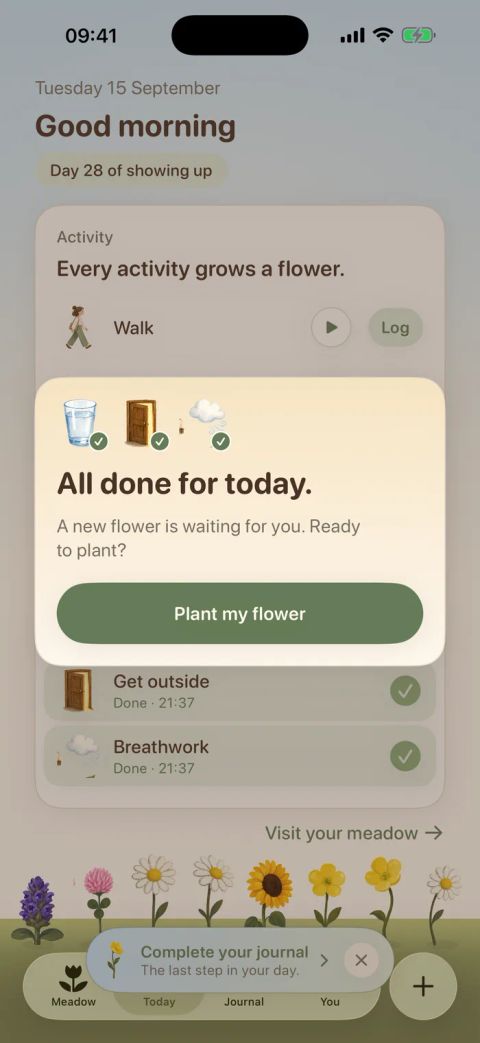
A paper sheet on the fridge works right up until you stop seeing it. If a nudge in your pocket suits you better, Meadow keeps the same idea somewhere you'll open anyway. It's a gentle iPhone app from Wildcard Wellness where you log a bit of movement or tick off a small habit, and every day you show up grows a new wildflower in a meadow that's yours, with a quick note on your mood and energy if you fancy it. There are no streaks, so a missed day resets nothing and the flowers you've already grown stay put, which takes the pressure off the bad-day line on your sheet, because a lap of the block still earns you something. You can try it at Meadow.
Common questions
How many goals should one worksheet cover? One. Maybe two if they're small. Trying to overhaul your sleep, diet, movement and screen time on the same page spreads your attention thin and most of it collapses by the second week. Get one action close to automatic, then fill in a fresh sheet for the next.
What if I don't know my obstacle yet? Leave it blank for a week and watch. The obstacle usually shows itself fast, the afternoon that vanishes, the evening you're too flat to move. Once you've seen it twice, write it in and add the if-then line. You can't plan for a barrier you haven't met.
Should the milestone be a number or an action? An action count, most of the time. "Fifteen walks this month" is something you can guarantee by turning up. "Lose four pounds" depends on things today can't move, so it belongs in the "why I want it" box as your direction, not in the milestone box as your job.
How often should I redo the sheet? Review it weekly and rewrite it whenever it stops fitting. A worksheet that never changes is one you've stopped reading. Change is a sign it's alive.
Do I have to use every box? No. If the milestone or the "why" feels forced, leave it and keep the action, the if-then line and the bad-day version, which are the three that carry the most weight. A shorter sheet you fill in beats a full one you avoid.
Copy out the worksheet now and fill in the top three lines only: your action, your after-I-will cue, and your bad-day version. That's enough to start on today, and you can add the rest at your first review.
AUTHOR
Co-founder of Meadow.
Ash is co-founder of Meadow, a habit and movement tracking app that turns small acts of self-care into a growing wildflower meadow.
Every little bit counts
Five minutes counts. So does a dance in the kitchen.
Log the movement you enjoy and the small habits that help you feel good, and watch them bloom into something you can see.
Download Meadow