There isn't one goal-setting framework that beats the rest. There's a handful of well-known ones, each built for a different job, and reaching for the wrong one is why so many good intentions stall by Wednesday. This guide walks through the five you'll meet most often, in plain English, and shows which suits a daily health habit, which suits a work target, and which suits a big open-ended life change.
The five are SMART, WOOP, OKRs, process goals and backward goals. Some sharpen a fuzzy wish into a checkable action. Some help you push through the moment you'd normally quit. One was built for company strategy and travels badly into personal life. By the end you'll know which to pick, and when to drop the frame entirely.
If you want the step-by-step setup rather than a tour of the options, how to set goals is the toolkit. This is the map of what's out there.
What a framework is for
A framework is a set of questions you run a goal through. Nothing more. "Get fit" is a wish with no edges, and a framework is the thing that turns it into an instruction you can act on this afternoon.
The research underneath most of them belongs to Edwin Locke and Gary Latham, who spent decades showing that specific, challenging goals beat vague encouragement like "do your best". We cover that in goal-setting theory. Every framework below is a different way of forcing that specificity out of you.
SMART: turn a wish into a checkable action
SMART is the one everybody's met. The letters stand for specific, measurable, achievable, relevant and time-bound, and you push a goal through the five until the vagueness is gone. "Read more" becomes "read ten pages after dinner on weeknights for a month."
The acronym is older than the blogs using it. It came from a one-page article by George Doran in a 1981 issue of Management Review, written for managers setting company targets, where the A and R stood for assignable and realistic. They've wandered since.
What SMART does well is squeeze a fuzzy intention into one concrete action with a number on it. That's most of the battle for an everyday habit. Where it struggles is anything you're still learning, and anything too big to name a number for yet. Our full guide to SMART goal setting takes the five letters one at a time.
Reach for SMART when you already know what to do and only need to pin down how much and by when.
WOOP: plan for the moment you'd quit
WOOP is the psychology-lab entry, and it does something the others don't. Instead of only naming what you want, it makes you face what stops you. The four steps are Wish, Outcome, Obstacle, Plan. You name a wish, picture the best outcome, then turn and look hard at the obstacle in yourself, and finally write an if-then plan for that obstacle.
Gabriele Oettingen built it on her research into mental contrasting, the trick of holding the good outcome and the real barrier in mind at once. The method's home page frames WOOP as a science-based mental strategy for changing habits. A pooled analysis of 21 studies covering nearly 16,000 people found it produced a small-to-moderate improvement in whether people reached their goals.
Your version might run like this. I want to move most days. The best bit would be more energy by evening. My obstacle is that I flop on the sofa the second I'm home. So if I get home and want to sit down, then I'll keep my coat on and walk to the postbox first.
Reach for WOOP when you know what to do and keep failing to do it. It's built for the follow-through gap, the space between deciding to act and acting.
OKRs: one ambition with a few measures of progress
OKRs come from the office, and it shows. The name stands for objectives and key results. The objective is the ambitious thing you want, written in plain words. The key results are the two to four measurable signals that tell you you're getting there.
Andy Grove built the method at Intel in the 1970s, adapting Peter Drucker's management by objectives, and John Doerr carried it to Google in 1999, from where it spread across Silicon Valley. A work example: the objective is "launch the new site", and the key results are "publish 20 pages", "cut load time to two seconds", "get 50 beta sign-ups".
You can bend OKRs to personal life. The objective might be to feel stronger by summer. The key results: three gym sessions a week for twelve weeks, one full pull-up, a 5k without stopping. One aim gets several honest measures instead of a single pass-or-fail line, so partial progress still counts for something.
Reach for OKRs when a goal is big and one number can't hold it, and you're happy to review the measures every few weeks. For a single daily habit they're overkill.
Process goals and backward goals: two ways to aim
These two are less frameworks than shifts in where you point your attention.
A process goal is the repeated action, not the result. Split any goal in two. The outcome is what you want: lose half a stone, run a 10k. The process is the action that might get you there: three short runs a week. You don't fully control the outcome, because it answers to sleep, stress and a dozen things today can't touch. What you control is whether you did the run. James Clear's line is that your goals set the direction and your daily system delivers the progress. So keep the outcome as a compass and run your days on the process.
A backward goal starts at the finish and works back. You fix the end point and a date, then step backwards to what has to be true a month before, a week before, tomorrow. A half-marathon in six months becomes a long run this weekend, which becomes a pair of shoes by the door tonight. It's a planning move that turns a far-off outcome into the next small thing.
Reach for a process goal whenever the outcome is slow or outside your hands, which covers most health habits. Reach for backward planning when there's a real deadline and you need a route to it.
Which framework for which goal
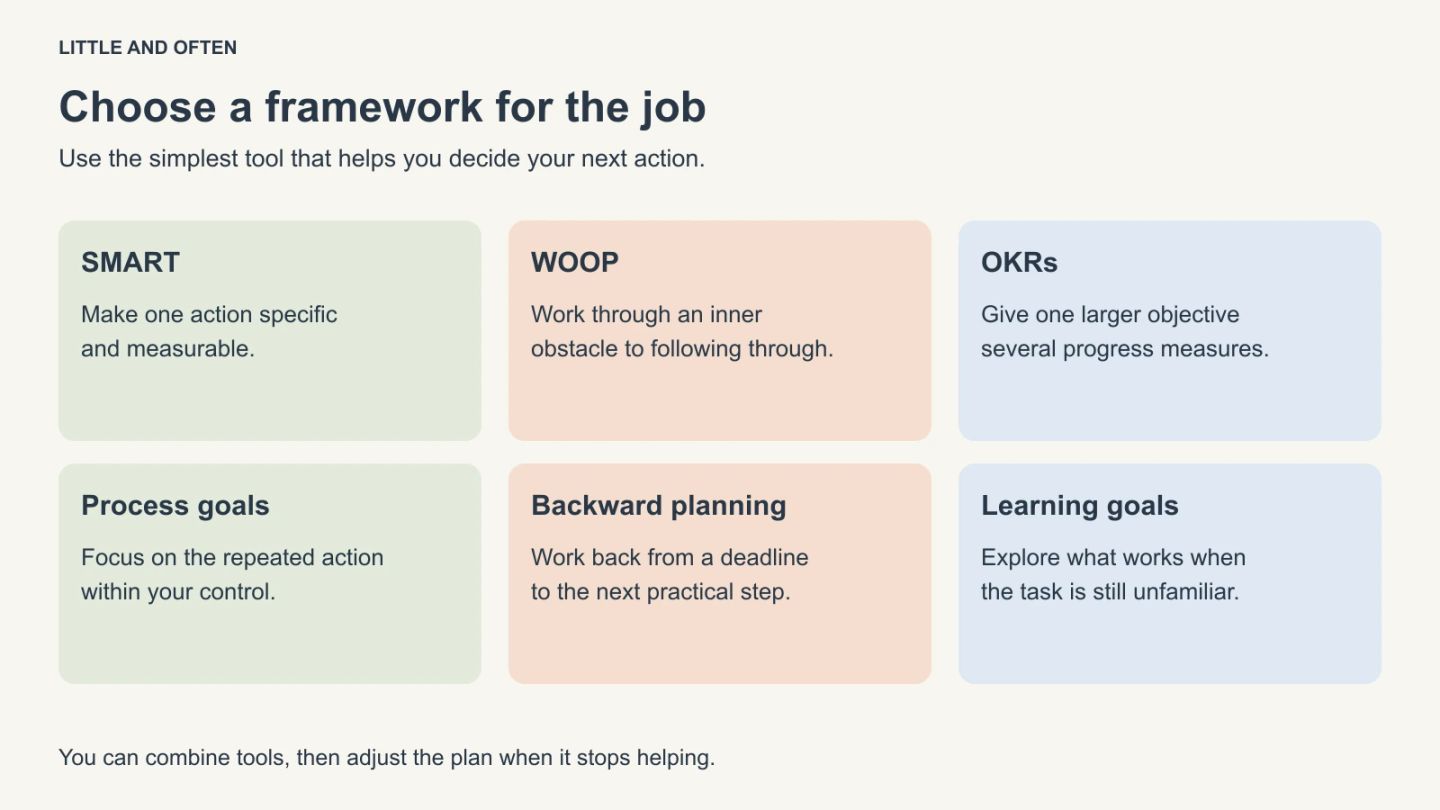
Line them up and the choice gets simpler. Match the frame to the job:
- A daily health habit like a walk after lunch or a glass of water on waking. Use SMART to name the action and the number, then run it as a process goal. Skip OKRs.
- A goal you keep abandoning. Use WOOP. The obstacle step is the part that catches the reason you quit last time.
- A big, vague ambition like getting stronger or feeling calmer. Start with a learning goal or an OKR that gives one aim several measures. A single SMART number too early can box you in.
- A hard deadline such as a race, an event or an exam. Plan it backwards from the date, then set process goals for the weeks in between.
- A work or team target. OKRs earn their keep here, with SMART for the individual tasks underneath them.
Most people end up combining them. A common mix is an OKR or a backward plan for the direction, SMART for the weekly action, WOOP for the goal that never sticks, and a process view throughout, so you're judging yourself on turning up.
The honest limits of any framework
A frame can do harm as well as good, and the productivity blogs skip this part.
The first cost is rigidity. A fixed number on something you're still learning raises stress and squeezes out the exploring you need to get good at it. Christian Swann, who studies goal setting, argues in Psyche that SMART goals are style over substance and can leave beginners feeling more pressure and less pleasure while they move. Sometimes an open goal like "see how far feels good today" produces results as good as a fixed target, with more enjoyment.
The second cost is that a goal can eat the thing it was meant to serve. A group led by Lisa Ordóñez laid this out in "Goals Gone Wild": a target narrows your focus, which is the point, but aggressive ones tempt people into cutting corners and drain the enjoyment that got them started. A step count can turn a nice walk into a chore you resent. When the number starts running the show, loosen it before you quit.
None of these frameworks are laws. They're tools for one job, sharpening a wish into an action. Use the frame while it helps, and put it down the moment the counting flattens the fun.
See the days add up

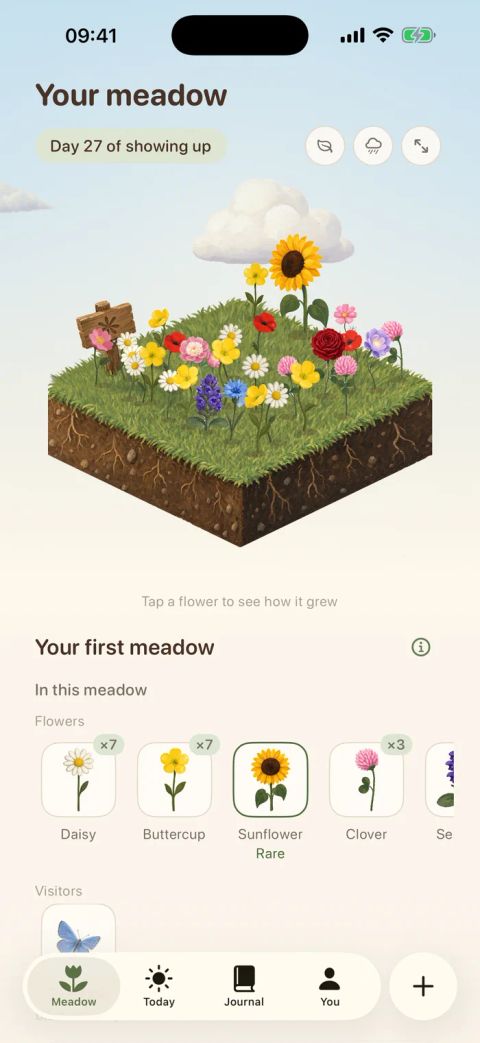
Whichever frame you pick, a goal only turns real once it becomes a thing you do on ordinary days, and that's the ground Meadow is built on. It's a gentle iPhone app from Wildcard Wellness where you log a bit of movement or tick off a small habit, and every day you show up grows a new wildflower in a meadow that's yours, with a quick note on your mood and energy if you fancy it. There are no streaks, so a missed day resets nothing and the flowers you've grown stay put, which takes the pressure off a plan that's meant to survive your worst week. You can try it at Meadow.
How to pick one this week
Don't collect frameworks. Pick the one that fits the goal in front of you and start. If you can name the action and a number, that's SMART, and it'll take two minutes on a scrap of paper. If you've tried before and stalled, run the goal through WOOP and write the if-then plan for your obstacle. If the goal is big and slow, break it into a process you can do this week.
Then judge yourself on whether you showed up, not on whether the outcome has arrived yet. Watching your own progress does real work. A review of 138 studies found that keeping track of how you're doing towards a goal makes you more likely to reach it. A wall calendar, an app, a tick on the fridge, whatever you'll see each day.
Common questions
Which goal-setting framework is best? There isn't a best one. SMART is best for pinning down a clear action, WOOP for follow-through, OKRs for big work goals that need several measures. Match the frame to the job in front of you.
Can I use more than one at once? Yes, and most people should. A typical mix is an OKR or a backward plan for the direction, SMART for the weekly action, and WOOP for the bit that keeps failing.
Are SMART goals overrated? For beginners, and for anything you're still learning, often yes. The measurable part helps sharpen a vague intention, but a rigid number early on can add stress and kill the enjoyment that brings you back. Loosen it when that happens.
What's the difference between OKRs and SMART? SMART sharpens one action until it's specific and countable. An OKR pairs one ambitious objective with a few measurable key results, so it suits a bigger goal that a single number can't capture.
How long until the habit sticks? There's no fixed number, whatever you've heard. Work by Phillippa Lally's team found the time varied hugely between people, and that missing one day didn't derail the process. Judge yourself on whether you're still turning up.
Pick the goal you're carrying right now and choose its frame in one line. If you know the action, write the SMART version with a number and a day. If you keep stalling, write the WOOP obstacle and its if-then plan. That single decision, made before you close the page, is the whole setup.
AUTHOR
Co-founder of Meadow.
Ash is co-founder of Meadow, a habit and movement tracking app that turns small acts of self-care into a growing wildflower meadow.
Little and often, with Meadow
Consistency, not intensity.
Meadow turns the movement you enjoy and the habits that help you feel good into a meadow of wildflowers. No streaks to break, and your flowers never wilt.
Download Meadow