Gamified habit formation borrows the parts of games that keep you coming back, the points, streaks, levels, badges and progress bars, and attaches them to the ordinary work of building a habit. The point is to make a repeated action feel rewarding today, long before the real benefit of the habit turns up.
Done with a light touch, it can carry you through the dull early weeks when a habit hasn't started paying off. Pushed too hard, it can quietly take over, so you end up chasing the points and losing the thing you wanted in the first place. This guide covers both, and how to keep the game on your side.
The mechanics behind a gamified habit
Most habit apps and trackers reach for the same handful of game elements. Knowing what each one does helps you spot which are working for you and which are noise.
- Points and scores. You earn a number for completing the habit. The number climbs, which gives you something to chase.
- Streaks. A running count of consecutive days. Miss one and the count resets to zero.
- Levels and progress bars. A visual sense of moving along a track, from beginner to further up.
- Badges and achievements. One-off rewards for hitting a milestone, like your first week or your hundredth session.
- Rewards and collectables. In-app currency, new content, a growing tree or garden, sometimes a small real-world prize.
- Leaderboards and challenges. Your progress set against other people's, or against a shared group goal.
A systematic review of health apps by Edwards and colleagues, published in BMJ Open in 2016, looked at 64 apps and found the most common elements were feedback and monitoring, comparison of behaviour, and reward systems. If a new tracker feels oddly familiar, that's because most of them draw from the same short list.
Why game mechanics can help a habit stick
The hard part of any new habit is the gap between the effort, which is now, and the reward, which is weeks or months away. A walk today does nothing you can feel today. Game mechanics fill that gap with a smaller reward you get on the spot.
James Clear makes this case for the humble habit tracker. Marking a habit off gives you an immediate hit of satisfaction, and, in his words, "the most effective form of motivation is progress". A filled-in row or a bar creeping upward is proof you're moving, and that proof pulls you back tomorrow.
Streaks add a second force. Once you've kept something going for eleven days, the eleven days themselves become worth protecting, and the fear of losing them can get you off the sofa on a night you'd otherwise skip. Psychologists call this loss aversion. Losing something we already hold stings more than gaining the same thing pleases us.
The evidence that this changes behaviour is real but modest. A systematic review by Xu and colleagues in JMIR mHealth and uHealth (2022) found that gamified interventions could increase physical activity, but that "the results were mixed, and modest changes were attained". Most of the studies had no long-term follow-up, so how well any of it holds once the novelty fades is still an open question.
That last point is the one to hold on to. Gamification is good at getting you started and carrying you through the first stretch. Whether it keeps a habit alive for good is where the honest limits begin.
The honest risks
It can crowd out the reason you started
The deepest risk is that the points replace the point. Decades of motivation research, gathered in a well-known meta-analysis by Deci, Koestner and Ryan (1999), found that tangible, expected rewards tend to undermine intrinsic motivation, the plain enjoyment of doing something for its own sake. In their figures, "engagement-contingent, completion-contingent, and performance-contingent rewards significantly undermined free-choice intrinsic motivation".
In everyday terms: if you run because you like running, and then you start earning coins for every run, your brain can quietly shift to running for the coins. Take the coins away and the running can drop below where it started. The game was meant to support the habit and ended up swallowing the reason for it.
The picture isn't one-sided. A 2024 study of gamified fitness apps by Huang and colleagues found that rewards and social recognition could feed intrinsic motivation rather than starve it, at least while people kept using the app. So the effect depends on the person and the design. The risk is real enough to build around, though.
Streak anxiety
A streak is a clever hook and a sharp double edge. The longer it runs, the more it hurts to break, until keeping the streak alive becomes a job of its own, separate from the habit it was meant to serve. People log a token session at 11pm to save the number. Others feel a jolt of dread the moment they realise they've slipped. At that point the tool is creating stress instead of easing a behaviour.
The same meta-analysis on rewards found the opposite pattern for encouragement. Positive feedback and praise enhanced motivation, while it was the tangible, keep-or-lose rewards that carried the sting.
Burnout when the pressure never lets up
Constant nudging, ranking and goal-chasing can tip from motivating into draining. A 2026 study in Frontiers in Public Health by Lin and colleagues traced how heavy engagement with gamified health tools can lead, through rising anxiety, to motivational exhaustion and burnout. Moderate engagement steadied people's mood, but "excessive immersion generates psychological tension". Roughly one in five people in the study showed a high-risk pattern of anxiety and burnout.
The game can outlive its usefulness, or die
Two failure modes sit at opposite ends. Sometimes the novelty wears off, the badges stop meaning anything, and the habit collapses along with your interest in the game. Other times the game becomes the whole point and the habit never grows past the version the app rewards. Either way, the Edwards review's finding rings true. Many apps pile on game elements with little grounding in how behaviour changes.
How to use gentle gamification
Gentle gamification keeps the game elements small and pointed at the habit, so they nudge without taking over. The aim is to let the reward fade into the background as the habit becomes its own reward.
- Anchor the habit to a cue first, then add the game. The reliable engine of a habit is a trigger you already have, not a points balance. Tie the action to something fixed in your day, like "after I make my morning coffee", and let the tracker record it rather than drive it. Our guide to the habit loop covers how cue, routine and reward fit together.
- Pick one or two mechanics, not the full arcade. A simple progress view or a daily tick is plenty. Leaderboards, currencies, levels and streaks all firing at once is where the pressure and the crowding-out live.
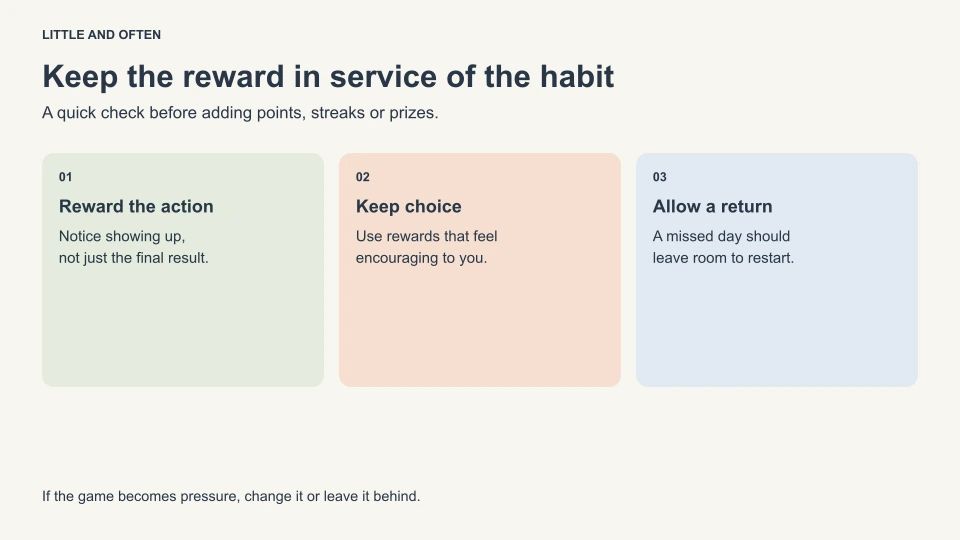
- Treat the streak as information, not a verdict. A long run is a nice signal that you've been consistent. A broken one tells you a day slipped, no more than that. If a reset would tempt you to give up entirely, choose a tracker that doesn't punish a miss.
- Keep the real goal in the room. Every so often, ask what you'd still want if the app vanished overnight. If the answer is "to keep walking", the game is doing its job. If it's "to protect my number", ease off.
- Shrink it for hard days. Decide now what the habit looks like on a flat, rushed day. One page instead of a chapter. A walk to the end of the road instead of a mile. A tiny version still counts, and it keeps you from an all-or-nothing miss. The tiny habits approach is built around this move.
A quick checklist for tuning your gamification
Run any habit app or tracker past this before you commit to it.
☐ Does it reward turning up, or only long streaks?
☐ Can I miss a day and keep what I've built?
☐ Are the game elements simple enough to ignore when I want to?
☐ Is the habit still doing something for me beyond the points?
☐ Does using it calm me down or wind me up?
If you're winding up more than winding down, that's your sign to strip the game back.
If you break a streak
One miss is not the failure that the red zero makes it feel. Real-world habit research by Lally and colleagues found that missing a single day had little effect on how automatic a behaviour eventually became, and that people vary hugely in how long a habit takes to settle. There's no streak you owe anyone. Do the small version at the next chance and carry on as though the number never counted, because it never did.
A calmer way to see progress bloom
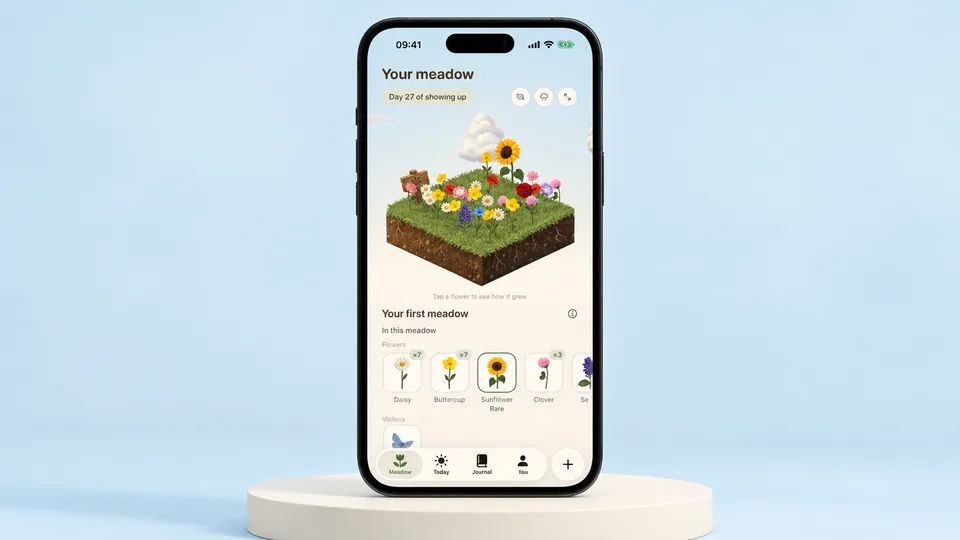
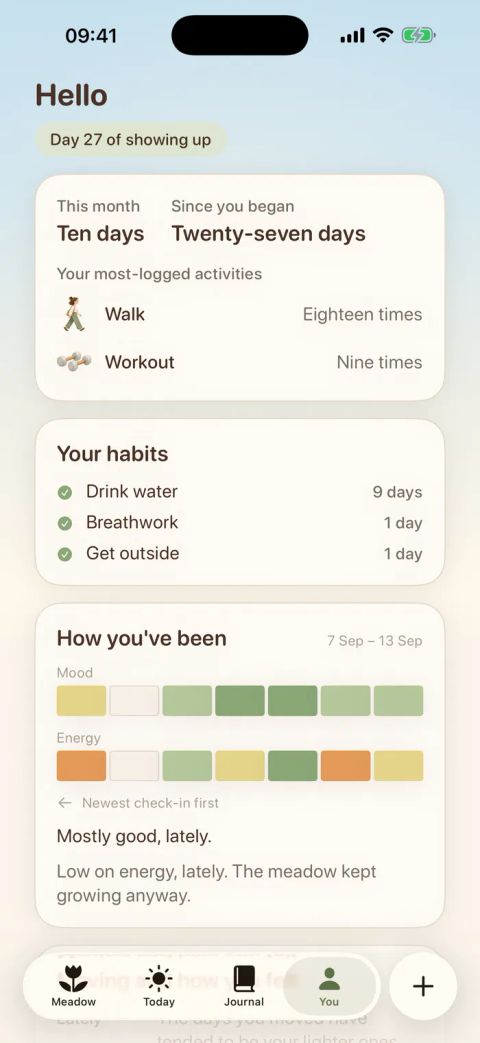
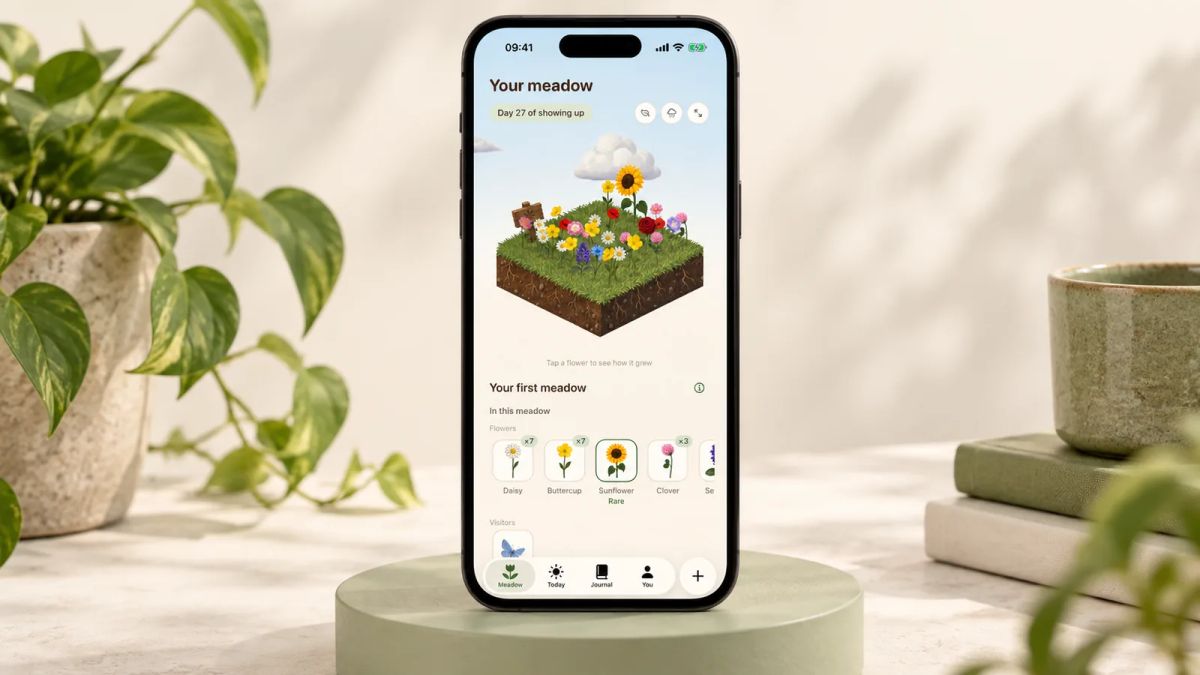
Some trackers turn a missed day into a punishment. Meadow does the opposite, and it shows what gentle gamification can look like in practice. It's a movement and habit app for iPhone from Wildcard Wellness where every day you show up, by logging a walk or a few minutes of movement, ticking off a small habit, or noting your mood and a daily win, a new wildflower grows in a meadow that's yours alone. Rare flowers appear now and then, and little animal visitors turn up as it fills in. There are no streaks, so a day you miss wipes out nothing and your flowers never wilt. The reward you're building towards is a garden slowly getting more beautiful, which is a softer pull than a number daring you to break it. You can see how Meadow works here.
Common questions
Does gamification work for building habits? It helps some people get started and stay engaged through the early weeks, and the research supports a modest boost to things like physical activity. The evidence for the long term is thin, and it works best when the game supports a habit you already have some reason to want.
Are streaks good or bad? Both. They're a strong motivator because we hate losing a run we've built, and that same force can turn into anxiety and token-logging. If a broken streak would push you to quit, use a tracker that forgives a miss.
Why do I lose interest once the novelty wears off? Because the game was carrying the motivation and the habit hadn't taken root underneath it. The fix is to grow the habit's own rewards, like the walk that clears your head, and lean less on the app's.
What's the difference between gamification and a plain habit tracker? A plain tracker records whether you did the thing. Gamification adds rewards, competition and progression on top to make the recording feel like play. For a closer look at trackers built for iPhone, see our roundup of the best habit tracker apps for iOS.
Pick one habit and one game element that points straight at it, a single daily tick or a small growing reward, and drop everything else for now. Then set a reminder for two weeks from today to ask one question: if the app disappeared, would I still want to do this? Let that answer, not the score, tell you whether the game is working.
AUTHOR
Co-founder of Meadow.
Ash is co-founder of Meadow, a habit and movement tracking app that turns small acts of self-care into a growing wildflower meadow.
See how far you've come
Your habits, moods and little wins, all in one place
Meadow keeps track of the walks, the water and the good days, so you can look back and watch your effort add up.
Download Meadow