If you want one book to start with, pick Mark Williams and Danny Penman's Mindfulness: A practical guide to finding peace in a frantic world. It's short, it's built around an eight-week plan, and it comes with guided audio, so you're practising within the first chapter instead of only reading about the idea.
No single book suits everyone, though, which is why this is a list and not one recommendation. Some people want the science and a structured course. Some want a gentle read for a hard week. Some want ten minutes a day with no incense in sight. Below are eight mindfulness books worth a beginner's time, with what each one is, who it tends to suit, and an honest line on where it falls short.
If you'd like to start before a book even arrives, our guide to mindfulness for beginners walks through a one-minute practice you can do right now.
How to get the most from a mindfulness book
A mindfulness book does nothing on its own. It works when you do the practices in it, not when you underline them and move on.
So read a chapter, then try the exercise it describes, even badly, before you read the next one. Most of these books include short practices you can do in a few minutes. A book you half-read and practise from will teach you more than one you finish and never sit with.
Eight mindfulness books worth starting with
Mindfulness: A practical guide to finding peace in a frantic world, by Mark Williams and Danny Penman
This is the book most UK mindfulness teachers hand to beginners. Mark Williams is an emeritus professor at Oxford who helped develop mindfulness-based cognitive therapy, and the book turns that clinical work into an eight-week home course. Each week gives you a short meditation with guided audio to follow, so you're never left guessing what to do. It's calm, practical and low on mysticism.
The eight-week structure rewards you for sticking with it, and that's also its catch. Some readers find the weekly homework hard to keep up with a full life. If that's you, do one practice a week and let the course take longer. You can read more about it on the authors' own site, Finding Peace in a Frantic World.
The Headspace guide to meditation and mindfulness, by Andy Puddicombe
If a course sounds like too much, this is the gentlest way in. Andy Puddicombe is a former Buddhist monk who went on to co-found the Headspace app, and the book keeps the same plain tone. No chanting, no cross-legged posture, no scented candles, as the publisher puts it. The promise is ten minutes a day. He explains what meditation is, walks you through his Take10 technique, and answers the worries most beginners bring with them.
It stays deliberately simple, so if you already sit or you want depth and science, you'll outgrow it fast. As a first book, that plainness is the whole point.
A mindfulness guide for the frazzled, by Ruby Wax
Ruby Wax wrote this for people who find the whole idea of mindfulness a bit much, which makes it a good pick for sceptics and the overwhelmed. She's a former comedian who went back to Oxford for a masters in mindfulness-based cognitive therapy, and the book mixes that training with jokes about her own frazzled head. There's real instruction inside, including a six-week practice section, wrapped in comedy that takes the earnestness out of it.
The humour won't land for everyone, and the science chapters stay near the surface. If you want a warm, funny push to begin, few books do it better. Penguin's page for A Mindfulness Guide for the Frazzled has more.
Wherever you go, there you are, by Jon Kabat-Zinn
Jon Kabat-Zinn brought mindfulness into mainstream medicine, and this is his most readable book. It's a collection of very short chapters, most only two or three pages, each a small meditation on paying attention in ordinary life. Read it front to back, or open it anywhere. It suits people who like to dip in and out, and anyone put off by a rigid programme.
It's reflective more than instructional, so you'll come away with gentle encouragement and a way of seeing, and only light how-to. Pair it with one of the practical books here if you want step-by-step guidance. The publisher's page for Wherever You Go, There You Are has an overview.
The miracle of mindfulness, by Thich Nhat Hanh
First published in 1975, this slim book is still one of the kindest introductions to mindfulness. The Zen teacher Thich Nhat Hanh shows how ordinary tasks become the practice, washing the dishes to wash the dishes, answering the phone, peeling an orange with full attention. It's quiet, warm and free of jargon, and the everyday focus makes it easy to try today.
Its roots are also its one caveat. The teaching comes from a Buddhist tradition and includes passages that assume some interest in that. Most beginners find it gentle, but it helps to know it isn't a secular self-help manual before you start. Parallax Press, the press connected to Thich Nhat Hanh's community, publishes it.
Full catastrophe living, by Jon Kabat-Zinn
This is the serious, comprehensive one, and it reads as a reference rather than a quick read. Kabat-Zinn built the mindfulness-based stress reduction programme now taught in hospitals around the world, and this book is that eight-week course in print, written for people living with stress, chronic pain or illness. If mindfulness has already helped you and you want to go deeper, or you're managing an ongoing health problem, it's the fullest guide on this list.
The catch is length. The revised edition runs past 600 pages, which can bury a total beginner. Start smaller and come here when you're ready to commit. Kabat-Zinn's own site describes Full Catastrophe Living in full.
When things fall apart, by Pema Chödrön
Pema Chödrön's book isn't a how-to, and that's why it earns a place here. It's a set of short teachings for hard times, written by an American Buddhist nun, about turning towards difficulty with curiosity instead of running from it. People often reach for it during grief, anxiety or upheaval, when a technique-heavy book feels beside the point.
Be clear on what it is before you buy. There are few step-by-step exercises, and the framing is openly Buddhist. As a companion for a rough patch it's hard to beat. As your first lesson in how to meditate, it isn't the one. The Pema Chödrön Foundation has details.
The power of now, by Eckhart Tolle (a note of caution)
The power of now has sold in the millions and shows up on every mindfulness list, so it's worth addressing head on. Eckhart Tolle's message is that most suffering comes from living in the past or the future, and that presence is the way out. Some readers call it life-changing.
Read the caution first. It's a dense, spiritual book that leans on terms like ego and Being, it makes no claim to evidence, and it isn't a practical how-to for someone who only wants to start meditating. Plenty of beginners bounce off it. If the everyday, secular books above appeal more, begin there and come to this one later, if at all. It sits on Eckhart Tolle's official site alongside his other work.
What mindfulness can and can't do
Before you spend money on a stack of books, it helps to hold realistic expectations. Mindfulness has real research behind it, and it's also oversold.
The US National Center for Complementary and Integrative Health, reviewing the evidence, reports that mindfulness-based approaches can work about as well as established therapies for anxiety and depression, show some benefit for sleep and blood pressure, and tend to produce small to moderate effects. The same review is frank that much of the underlying research is low quality, and that around 8 percent of people had a negative effect from practising meditation, most often more anxiety or low mood.
Treat these books, then, as a low-cost way to build a calming daily habit, not a cure. If sitting with your thoughts leaves you more agitated, it's fine to stop or shorten the practice. And if low mood, anxiety or worry hangs around for weeks or gets in the way of ordinary life, talk to your GP. That's a sensible next step whatever you happen to be reading.
For gentler ways to look after yourself alongside a reading habit, our list of self-care ideas has plenty that take only a few minutes.
Somewhere to practise between chapters
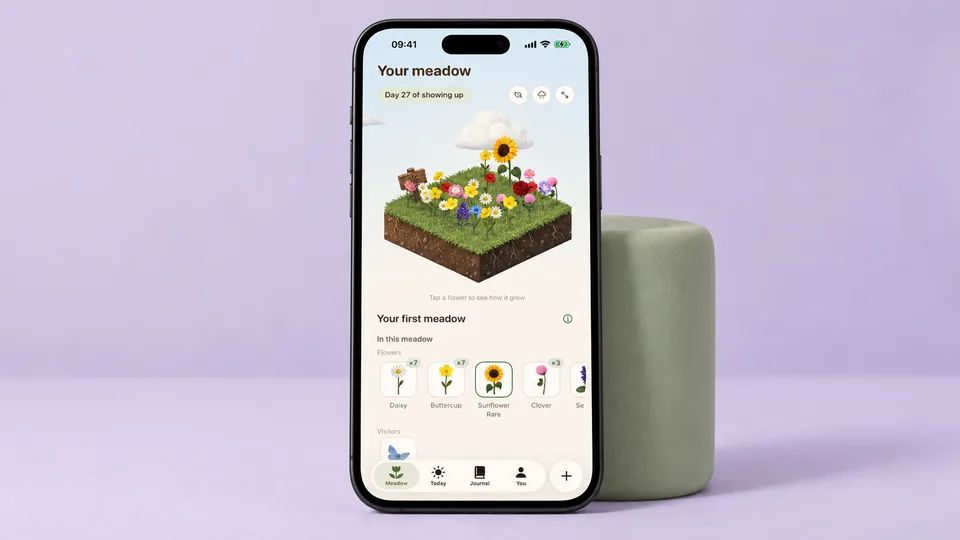
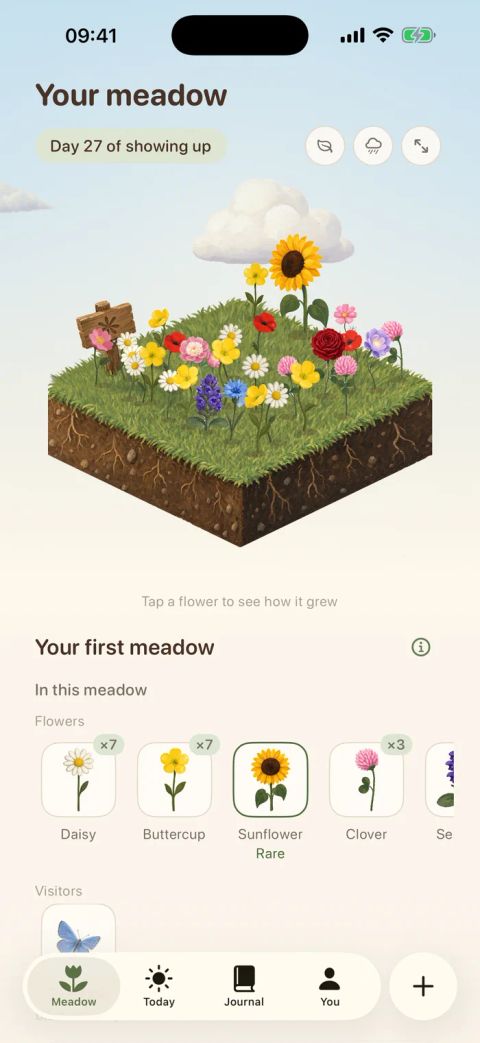
A book gives you the idea, and the practice is the part that changes anything. If you'd like the daily side to live on your phone, Meadow has a built-in breathwork feature you use alongside a wildflower meadow you grow by turning up. Meadow is a gentle movement and habit app for iPhone where you can tick off a small daily habit like five minutes of mindful breathing, log a walk, and note your mood and energy. Each day you show up, a new flower blooms. There are no streaks, so a week you don't open a book or sit down to breathe resets nothing, and the flowers never wilt.
Frequently asked questions
What's the best mindfulness book for a complete beginner?
For most people, Mark Williams and Danny Penman's Mindfulness: A practical guide to finding peace in a frantic world. It's short, structured as an eight-week plan, and comes with guided audio, so you practise from the start instead of only reading. If a course feels like too much, Andy Puddicombe's The Headspace guide to meditation and mindfulness is a lighter first step.
Do I need a book if I already use an app?
No. Apps and books do slightly different jobs. An app hands you guided sessions and a nudge to show up, and a book explains the why and gives you a fuller picture. Many people use one of each. If you'd like to build the daily habit, our guide to how to start a daily meditation habit covers the mechanics.
Are mindfulness books religious?
Some are and some aren't. Williams and Penman, Ruby Wax and Andy Puddicombe write in secular, everyday terms. Thich Nhat Hanh and Pema Chödrön write from Buddhist traditions, and Eckhart Tolle from a broader spiritual view. None of them require a belief, but it's worth knowing the flavour before you buy.
How many should I read?
One, to begin with. A single book you read and practise from will do more for you than a shelf you skim. Add a second only once the first has become a small daily habit.
The thing to do today is pick one book, not a pile. Choose the one that matches where you are this week, order or borrow it, and read the first short chapter tonight, then try one practice from it before you read any further.
AUTHOR
Co-founder of Meadow.
Ash is co-founder of Meadow, a habit and movement tracking app that turns small acts of self-care into a growing wildflower meadow.
Little and often, with Meadow
Consistency, not intensity.
Meadow turns the movement you enjoy and the habits that help you feel good into a meadow of wildflowers. No streaks to break, and your flowers never wilt.
Download Meadow